7 October 2026
Why Your Child Can Read But Can't Spell, and How to Fix It
Why Your Child Can Read But Can't Spell, and How to Fix It
posted on : 7 October 2026
Your child reads a chapter book without blinking. Then they write "becos" for because, "frend" for friend, and "sed" for said.
On Friday they got 10 out of 10 in the dictation test. By Monday the same words are gone.
So you are left with a question that makes no sense on the face of it. How can a child who reads a word a hundred times still not know how to write it?
Here is the short answer. If your child can read but can't spell, it's because reading and spelling use the same knowledge in two different directions, and your child has only built it in one.
Reading lets them work with a partial picture. They see the first letter, the shape, the rest of the sentence, and they land on the word.
Spelling allows none of that. Spelling asks for every letter, in order, from memory, with nothing on the page to help.
That's why a good reader can be a poor speller, and why more spelling tests will not fix it.
This guide explains which half is missing, how to check it in ten minutes tonight, and what to do about it. It also covers the dictation trap that fools almost every parent, including the ones whose children score full marks.
In this guide:
Why can my child read but can't spell? · Reading and spelling are the same knowledge in two directions · Is it normal for a 6 year old to read well and spell badly? · Why does my child pass the dictation test on Friday and fail on Monday? · Five reasons a strong reader spells badly · How do I help my child with spelling at home? · When should you worry about spelling? · FAQs about reading well and spelling badly
Why Can My Child Read But Can't Spell?
A child can read but can't spell because reading only needs enough of a word to recognise it, while spelling needs all of it, in the right order, with no clues on the page. Recognising is easier than producing. So reading almost always runs ahead of spelling, and for many children the gap is wide.
Think about what each task actually asks.
When your child reads "friend", the letters are sitting right there. They can use the f, the shape of the word, the rest of the sentence, and the fact that they have met it before. Several weak clues add up to one correct answer.
When your child writes "friend", the page is blank. No shape to recognise. No sentence to lean on. They have to pull out eight letters in exact order, including an "i" that says nothing at all.
Reading is a multiple-choice question. Spelling is a blank sheet.
Two words worth knowing
Decoding is turning letters into sounds to read a word. Your child does this when they look at "sat" and say sss-a-t.
Encoding is the opposite. It is turning sounds into letters to write a word. Your child does this when they hear "sat" and write s, a, t.
Most phonics teaching at school spends far more time on decoding than encoding. Children get hours of reading practice and a weekly spelling list. The reading half gets taught; the spelling half gets tested.
Reading and Spelling Are the Same Knowledge in Two Directions
Reading and spelling draw on one store of knowledge about how words are built, so the fix for weak spelling is almost always to go back and build that store properly, in both directions. They are not two separate subjects.
Researcher Linnea Ehri describes how this store gets built. In her work on orthographic mapping, published in Scientific Studies of Reading in 2014, she explains that the process "involves the formation of letter-sound connections to bond the spellings, pronunciations, and meanings of specific words in memory."
Her description of what happens is worth reading twice: "when readers see a new word and say or hear its pronunciation, its spelling becomes mapped onto its pronunciation and meaning. These mapping connections serve to 'glue' spellings to their pronunciation in memory."
Glue is the useful word. A word that is glued properly can be read and written. A word that is only half glued can be read and not written.
That's the whole problem in one sentence. Your child has a shelf full of half-glued words.
And half-glued is what you get from memorising a shape rather than mapping the sounds inside it. The word goes in for Friday and slides out by Monday, because nothing was holding it.
Is It Normal for a 6 Year Old to Read Well and Spell Badly?
Yes. A gap between reading and spelling is typical at ages 5 to 8, and in most children spelling runs behind reading at this stage. What's worth attention is a gap that stays the same size, or widens, across a whole school year of teaching.
Most children follow a rough pattern. The table below is what our teachers see most often across 35+ countries, not a published standard, so treat it as a guide to the shape of things. Class names differ around the world, so ages come first.
Age | School year (UK / US and Canada / India / Gulf) | Reading typically | Spelling typically |
5 | Reception / Kindergarten / UKG / KG2 | Sounds out simple three-letter words | Writes some sounds in a word, often the first and last: "kt" for cat |
6 | Year 1 / Grade 1 / Class 1 | Reads simple sentences, some words by sight | Writes words the way they sound: "becos", "sed", "rite" |
7 | Year 2 / Grade 2 / Class 2 | Reads fluently, reads to learn | Common words mostly right, longer and irregular words wrong |
8 | Year 3 / Grade 3 / Class 3 | Reads chapter books | Spells most common words, still guesses at vowel teams and endings |
School years start at different times: April in India, and around September in the UK, the US, Canada and most Gulf schools. Where this guide says watch the gap over a full school year, count from whenever your child's year began.
Screenshot this table. The two right-hand columns are the ones to compare, and the gap between them is the thing to watch over a year.
Writing words the way they sound is not a mistake at 6. It's evidence your child is using the code. A child who writes "becos" heard every sound and wrote a letter for each one. That child is in better shape than one who writes a memorised shape they cannot sound out.
For what is typical at each age when nothing is wrong, see our guide to reading milestones by age.
Why Does My Child Pass the Dictation Test on Friday and Fail on Monday?
A child passes Friday's dictation and fails on Monday because they memorised the list for the test rather than mapping the words, and a memorised list rarely survives more than a few days. The marks measure short-term memory.
This is the single most common thing we see, and it is the reason parents think their child is doing fine until the school year turns and nothing has stuck.
Weekly dictation works like this almost everywhere. The list comes home on Monday. Your child reads it, copies it, maybe chants it. By Friday they can hold twelve words in their head long enough to write them down. Full marks. Everyone is pleased.
Nothing about that process glues anything.
Memorised for the test | Mapped into memory |
Can write the word on Friday | Can write the word in March |
Cannot say which sounds are in it | Can break it into sounds and say why each letter is there |
Gets it wrong inside a sentence | Gets it right in a story, a message, a worksheet |
Spells it right only in list order | Spells it right in any order |
Falls apart on a word that looks similar | Transfers to similar words |
The test to run tonight takes two minutes. Pick four words from a dictation list your child scored full marks on, three or more weeks ago. Say them in a sentence and ask your child to write them.
If most are gone, you have your answer, and it is not that your child is careless. The method was never going to hold.
Five Reasons a Strong Reader Spells Badly
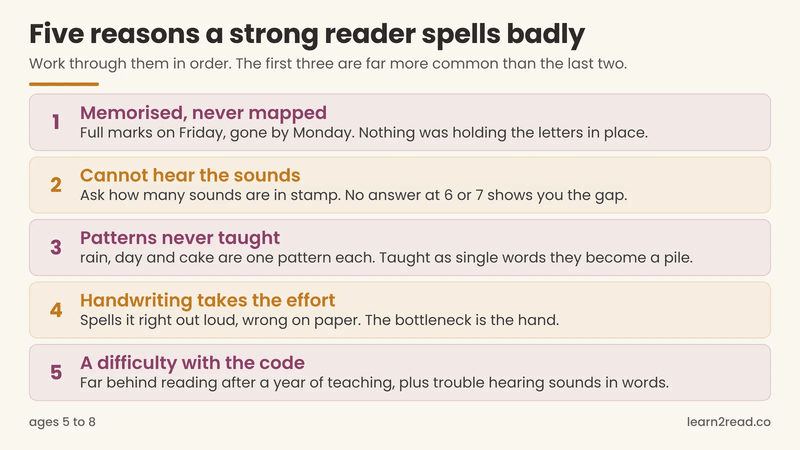
Five things produce a child who can read but can't spell: words memorised rather than mapped, an inability to break spoken words into sounds, spelling patterns never taught, handwriting taking all the effort, and a specific difficulty with the written code. Only the last is a learning difficulty. Work through them in order, because the first three are far more common than the last two.
1. The words were memorised, never mapped
Covered above, and it accounts for more cases than everything else here put together. The fix is in the next section.
2. Your child cannot break a spoken word into its sounds
Spelling starts in the ears. Before a child can write "stamp" they have to hear five sounds in it: s, t, a, m, p. Plenty of fluent readers never built this skill, because strong readers can get by on shape and context without it.
Try this. Say "stamp" and ask your child how many sounds are in it. Then say "lunch", then "drink". A child at 6 or 7 who cannot do this is telling you where the problem is, and it's a fixable one. Our guide on how to teach blending works the same skill in the reading direction.
3. Nobody taught the spelling patterns, only the words
English has far more ways of writing its sounds than it has letters. The long a sound alone appears as "ai" in rain, "ay" in day, "a_e" in cake. A child who has met these as patterns has a system. A child who has met rain, day and cake as three separate words to remember has a pile.
This is why your child spells "rane" and "daiy". They are using one pattern for every job, which is a sensible thing to do when nobody gave them the others.
4. Handwriting is taking all the effort
If forming letters is still slow and physical, there's little attention left over for which letters to choose. The spelling looks worse than the knowledge actually is.
The tell: your child spells a word correctly out loud, then writes it wrong. If that happens often, the bottleneck is the hand.
5. A specific difficulty with the written code
For some children the pattern runs deeper. Spelling that stays far behind reading through a year of proper teaching, alongside trouble hearing sounds in words and a family history of reading or spelling difficulty, is worth looking at properly. Our guide to the early signs of dyslexia in children covers what to look for and the five ordinary things that look the same.
More likely to be something else | More likely to be worth a closer look |
Spells the way the word sounds: "becos", "sed" | Spellings with no link to the sounds: "bnt" for because |
Improved after a few weeks of sound work | No change after months of proper teaching |
Spells it right out loud, wrong on paper | Cannot do it in either direction |
Spelling is about a year behind reading | Spelling is years behind, and the gap keeps growing |
Nobody in the family found spelling hard | A parent or sibling found reading or spelling hard |
How Do I Help My Child With Spelling at Home?
To help a child who can read but can't spell, stop practising lists and start practising sounds inside words: say the word, break it into sounds, write a letter for each sound, then check it against the real spelling. Ten minutes, four days a week, beats an hour on Sunday.
Here is the routine. It works on any word, including the ones on this week's list, so it replaces your current spelling practice instead of adding to it.
Step | What you do | What it builds |
1. Say it | Say the word slowly. Your child repeats it. | Hearing the whole word |
2. Break it | Your child taps out the sounds on their fingers: s-t-a-m-p, five taps | Hearing the parts |
3. Write it | One letter or letter group per sound, left to right | The mapping |
4. Check it | Compare with the correct spelling. Your child circles only the part that differs. | Precision, without rewriting the whole word |
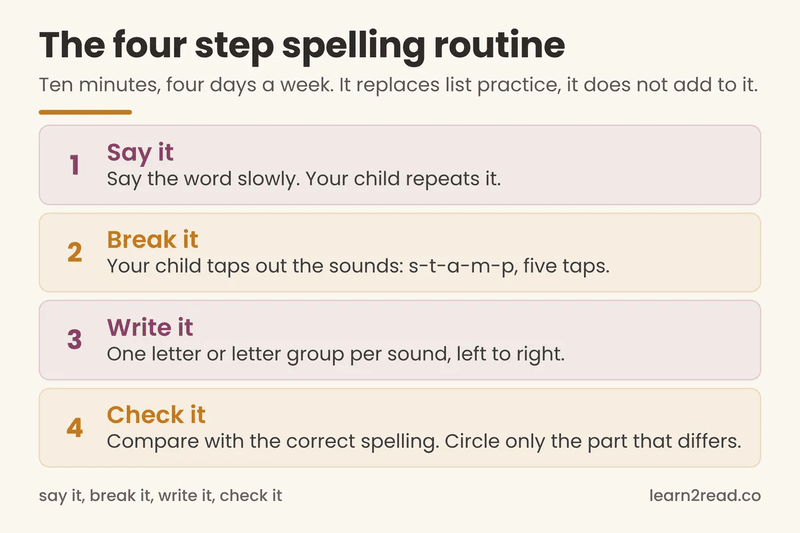
📌 Screenshot this one. It is the table worth sending to your parent group, and it fits a phone screen.
Step 4 is where most home practice goes wrong. When a child gets "because" wrong, the usual response is to make them write it five times. That drills the hand and teaches nothing. Circling the one part that was wrong, the "au" in the middle, puts their attention exactly where the gap is.
Four more things that move the needle:
Say the sound, never the letter name. When you break down "stamp", say sss and t, not "es" and "tee". Letter names are no help at all for spelling, and for some children they are an active obstacle.
Write lowercase. Books are printed in lowercase and children meet it first. Write s, a, t, p the way they will see them.
Keep a short list of the words your child actually gets wrong. Skip the school's list. Six words your child misspelled in their own writing this week are worth more than twelve words chosen for the whole class.
Let them write things that matter. A note to a grandparent, a shopping list, a label for a drawing. Spelling practised only on worksheets stays on worksheets.
The National Reading Panel review, reporting in 2000, found that explicitly and systematically teaching children to manipulate phonemes significantly improves reading and spelling. Working with the sounds inside words lifts spelling as well as reading. The word "systematically" is doing real work in that sentence. A planned order, taught the same way each time, is what separates this from the pile of random worksheets.
Which Spelling Words Are Worth Practising?
Practise the words your child uses most and gets wrong most, plus the pattern behind each one. Skip the long and unusual words, because they teach one word each, while a pattern teaches hundreds.
Worth your ten minutes:
The common words your child keeps getting wrong in their own writing: said, because, friend, they, want, there
Words that follow a pattern your child has not met yet, taught as a group: rain, train, wait together, then day, play, say
Words with endings that come up constantly: jumped, jumping, bigger, happiest
Not worth your ten minutes:
Long words from a topic list that will not appear again this year
Words your child already spells correctly, rewritten for neatness
Any word practised by copying it out ten times
A note on the awkward ones. English has words that genuinely have to be learned as oddities, and "said" is the classic. Teach those as the small, named exception group they are, so your child knows there is a short list of troublemakers. Our guide to sight words for kids covers how to handle them without turning every word into a memory test.
When Should You Worry About Spelling?
Raise spelling with your child's teacher when it has stayed far behind reading through a full year of teaching, when your child cannot break spoken words into sounds by age 7, or when their spellings have no link to the sounds in the word. A gap that is closing, however slowly, is not the one to worry about.
Two things make that conversation useful instead of vague.
Bring examples. Two weeks of your child's own writing, with dates, tells a teacher more than any description. At a parent-teacher meeting (PTM), "she writes becos and sed, and she cannot tell me the sounds in stamp" gets a real answer. "I am worried about her spelling" usually gets "she is doing fine".
Ask one specific question: is my child taught spelling patterns in a planned order, or a list of words each week? The answer tells you what is happening in class, and what you need to cover at home. Our guide on what to ask your child's teacher about reading has more questions worth that ten-minute slot.
Nothing in this guide is a diagnosis. If several things here sound like your child and the picture has not moved in six months, bring your notes to the teacher and to your paediatrician, and ask what the assessment route looks like where you live.
One thing to hold on to. A child who spells words the way they sound is not failing at spelling. They are using the code, which is exactly what you want them to do, and they are two steps from accurate spelling rather than ten.
At Learn2Read, a live online phonics programme where trained teachers work with children aged 3 to 12 across 35+ countries, a good number of the children we teach can read but can't spell when they arrive. It's one of the more fixable gaps in early literacy.
FAQs About Reading Well and Spelling Badly
Why can my child read a word but not spell it?
Reading a word only needs enough information to recognise it, while spelling it needs every letter in order with nothing on the page to help. Your child can use the first letter, the shape and the rest of the sentence to read "friend", and none of those exist when the page is blank. That is why reading runs ahead of spelling, and why the gap is widest for words with letters you cannot hear.
Is it normal for a good reader to be a bad speller?
Yes, and it is common. At ages 5 to 8 spelling typically runs behind reading, because recognising a word is easier than producing one. The gap itself is normal. A gap that stays the same size or grows across a full school year of teaching is the one worth raising with the teacher.
Why does my child forget spellings after the test?
Because the words were memorised for the test rather than mapped into memory. A list held in short-term memory for three days leaves nothing behind. A word is only stored for good once a child can break it into its sounds and say why each letter is there, which is what makes it available in March as well as on Friday.
How can I help my child with spelling at home?
Replace list practice with four steps on each word: say the word, have your child tap out its sounds, write one letter or letter group per sound, then compare with the correct spelling and circle only the part that differs. Ten minutes on four days beats one long weekend session, and the words to use are the ones your child gets wrong in their own writing.
Does bad spelling mean my child is dyslexic?
On its own, no. Spelling words the way they sound is a normal stage and a sign your child is using the code. Spelling becomes worth a closer look when it stays far behind reading through a year of proper teaching, when a child cannot hear the separate sounds in a spoken word by about age 7, and when there is a family history of reading or spelling difficulty. Those things together are a reason to ask the school, not a diagnosis.
Should I correct every spelling mistake in my child's writing?
No. Correcting everything teaches a child that writing is a test, and the usual result is shorter, safer writing with smaller words. Pick two words from a piece of writing, fix those properly using the four steps, and leave the rest. The goal this year is a child who writes plenty and spells more of it correctly over time.
Do spelling apps and games work?
They help with practice once a child understands how words are built, and they do very little before that. An app that drills word shapes is a faster version of the thing that was not working. Look for one that asks your child to build words from sounds, and treat it as extra practice alongside the four steps rather than a replacement for them.
Read Next
How to Teach Blending because reason 2 is where most parents land, and blending is the same sound work in the reading direction.
Early Signs of Dyslexia in Children for when spelling is one of several things that are not moving.
My Child Can Read But Doesn't Understand because the other half of reading can go missing in exactly the same quiet way.
If any of this sounds like your child, the most useful next hour is one where a trained teacher works through a few words with them, finds exactly where the mapping breaks down, and shows you how to practise it at home.
Written by Nitin Jain, Founder, Learn2Read. Reviewed by the Learn2Read teaching team, October 2026. Learn2Read teaches phonics and early literacy to children aged 3 to 12 through live online classes in 35+ countries.

Latest Posts
3 October 2026
Early Signs of Dyslexia in Children: Ages 4 to 7, and 5 Things That Look Like It
30 September 2026
My Child Can Read But Doesn't Understand: Why It Happens and How to Fix It (Ages 5 to 8)
26 September 2026