
7 October 2026
When Your Child Cries at School Drop-Off: What to Say

When Your Child Cries at School Drop-Off: What to Say
posted on : 23 September 2026
The uniform fits. The bag is packed. You practised the walk to school and talked about how good it would be. Then you reach the gate, your child's grip tightens, and the crying starts.
Walking away while your child cries is one of the hardest small moments of parenting. This guide gives you the exact words that help, the common ones that quietly make it worse, a 30-second goodbye routine that pediatricians recommend, and a clear picture of when drop-off crying is normal and when it's worth a closer look.
You'll be off the school gate in under a minute, and your child will be okay. Here's how.
Why Do Children Cry at School Drop-Off?
Children cry at drop-off because being apart from you feels genuinely unsafe to a young brain. It isn't a sign that something is wrong with your child, your parenting, or the school. Psychologists call this separation anxiety, and the American Academy of Pediatrics describes it as "an entirely normal behavior and a beautiful sign of a meaningful attachment".
Separation anxiety at drop-off is a normal stage for children aged 3 to 6, and pediatricians treat it as evidence of healthy attachment rather than a problem to fix.
Here's the part nobody tells you at the gate: for most children the tears stop within minutes of you leaving. Teachers watch it happen every morning. The child sobbing at 8:55 is stacking blocks at 9:02. The goodbye is the storm. You just never get to see the calm that follows it.
That doesn't make the crying meaningless. It means your job isn't to prevent the tears. It's to make the goodbye feel safe, short and predictable, and the words you choose do most of that work.
Say This, Not That at the School Gate
Most of us reach for comfort phrases that accidentally tell a child their feelings are wrong. The fix is to allow the feeling first, then anchor the safety. Screenshot this for tomorrow morning.
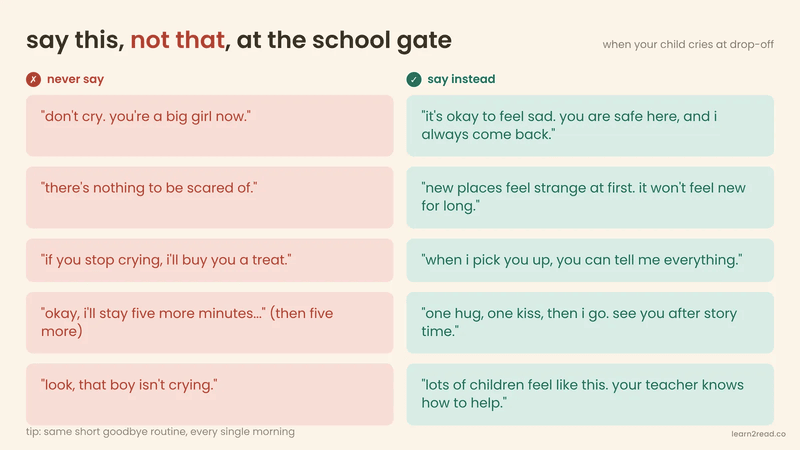
❌ Never say | ✅ Say instead |
"don't cry. you're a big girl now." | "it's okay to feel sad. you are safe here, and i always come back." |
"there's nothing to be scared of." | "new places feel strange at first. it won't feel new for long." |
"if you stop crying, i'll buy you a treat." | "when i pick you up, you can tell me everything." |
"okay, i'll stay five more minutes." (then five more) | "one hug, one kiss, then i go. see you after story time." |
"look, that boy isn't crying." | "lots of children feel like this. your teacher knows how to help." |
Why do the left-column phrases backfire?
"Don't cry" asks a child to hide a feeling they can't switch off. The tears go underground and the worry stays. Naming the feeling is what actually shrinks it.
"There's nothing to be scared of" argues with their reality. To a four-year-old, a room of strangers is genuinely frightening. You'll win more trust with "new feels strange at first", because it's true and children can hear the difference.
Bribes turn goodbye into a negotiation, and tomorrow the price goes up. A promise of connection costs nothing and gives your child something to look forward to that includes you.
Stretching the goodbye stretches the pain. The AAP's advice is blunt: "keep the goodbye short and sweet. If you linger, the transition time does too." A long, wavering goodbye teaches your child that crying hard enough might make you stay.
Comparisons add shame to fear. Now your child feels frightened and not good enough. Point them at the helper instead, so they know who their safe person is once you've gone.
And one that isn't a phrase: never sneak out while your child is distracted. It feels kinder in the moment. But when they look up and you have vanished, what they learn is that you might disappear at any time, so they need to watch you every second. Tomorrow gets harder, not easier. Always say goodbye, briefly and warmly, and then actually go.
Build a 30-Second Goodbye Routine
A goodbye routine is a short, identical sequence you repeat every school morning. Same steps, same order, same words. Predictability is what turns a frightening goodbye into an ordinary one, and the AAP specifically recommends keeping the routine, the timing and the drop-off spot consistent so your child learns to trust the pattern.
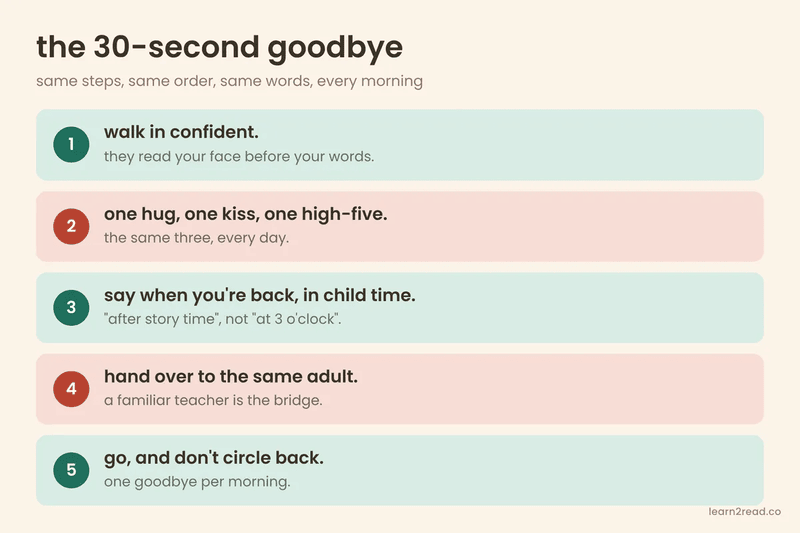
Here's one that takes under 30 seconds:
Walk in confident. Children read your face before your words. Bright voice, sure steps, and the message is "this place is safe".
One hug, one kiss, one high-five. The same three, every day. Some families add a kiss pressed into the child's palm to keep in their pocket for later.
Say when you'll be back, in child time. Not "at 3 o'clock", which means nothing at four, but "after story time" or "after afternoon snack". For a longer gap, "after two sleeps" beats "on Thursday".
Hand over to the same adult. A familiar teacher's arms are the bridge between you and the classroom. Say it cheerfully: "Ms. Rivera, Aarav is ready for you."
Go, and don't circle back. The AAP warns that returning mid-goodbye "extends anxiety and requires restarting the process". One goodbye per morning. If you want reassurance, ring the school office later. Most will happily tell you your child settled in minutes.
If school hasn't started yet, you can rehearse. Leave your child with a grandparent or a trusted friend for short stretches beforehand, using the exact same routine. The AAP calls these practice separations, and they work like a fire drill: the real thing feels familiar because the body has already done it.
What Drop-Off Tears Mean at Every Age
Age | What the tears usually mean | What helps most |
2-3 (playgroup, nursery) | first real separations. loud tears that usually stop fast once you leave | short routine, same timing, same drop-off adult |
3-4 (preschool) | your child can now anticipate the goodbye, so tears may start at breakfast | talk about the good part of the day ahead, not the goodbye. keep mornings calm and unhurried |
4-5 (kindergarten, reception) | big-school worries: where's the toilet, who helps me at lunch | answer the practical worries. a walk-through of the school beforehand works wonders |
6-8 (grade 1 and up) | a sudden return of tears after settled years usually means something specific | gentle bedtime questions, and a quiet word with the teacher |
That last row matters most. A sudden return of drop-off tears in a six or seven-year-old who was previously settled usually points at something specific: a friendship wobble, a subject they're struggling with, a change at home. Don't interrogate at the gate. Ask sideways questions at bedtime. "Who did you sit with today?" "What's the trickiest part of the day?" Children answer sideways questions.
When does ordinary drop-off crying fade? For most children, within the first few weeks of a new class, as the routine becomes familiar. The AAP notes it's rare for separation anxiety to persist on a daily basis after the preschool years.
Hard Morning, Harder Afternoon? That's Normal Too
Many parents notice a strange pattern: a tearful drop-off, a teacher's report of a lovely settled day, then a complete meltdown the moment the child spots you at pickup.
That afternoon explosion has a name: restraint collapse. Your child spent every drop of self-control holding it together at school, and you are their safe place to fall apart. It's the same nervous system behind the morning tears, and we wrote a full guide to it in After-School Meltdowns: Why Your Child Falls Apart at Home.
Two rules for the pickup hour on a tearful-morning day.
Don't open with the morning. "Why were you crying today?" makes a child relive it. Try "I'm so happy to see you", hand over a snack, and let the day come out on its own.
Reconnect before you correct. Ten quiet minutes together, a snack, a cuddle, a picture book at bedtime, refills the connection the day drained. A shared book is especially good here because it's closeness with a built-in script. No questions to answer, just your voice and a story.
The Confidence Trick Most Parents Miss
Here's something teachers quietly know: children walk into school taller when one thing inside already feels easy.
For children aged 4 to 8, the centre of every school day is letters, sounds and reading. A child who already knows their letter sounds, who can look at the classroom wall and think "I know those", carries a little armour through the gate. School stops being a place of unknowns and becomes a place where they can shine.
At Learn2Read, a live online phonics program for children aged 3 to 12, our teachers see this every September. The children who settle fastest are rarely the boldest ones. They're the ones who feel capable. Ten minutes of playful phonics a few times a week is one of the simplest confidence-builders a nervous starter can have.
When Morning Tears Need More Help
Most drop-off crying is normal and fades. Talk to your child's teacher, and then your doctor, if you notice:
tears that escalate week after week instead of easing
tummy aches or headaches every school morning, sometimes starting Sunday night
crying that continues long after you leave. Ask the teacher rather than guessing
your child refusing to enter school at all, or begging to stay home daily
big changes in sleep, eating or toileting since school began
None of these means something is wrong for certain. They mean it's time to bring in your child's other adults. The AAP's advice is simple: if your child doesn't seem to be adapting to separations, your pediatrician can offer reassurance and help you build a plan. That isn't overreacting. That's parenting well.
Frequently Asked Questions
Should I sneak out while my child is distracted?
No. Sneaking out avoids one hard goodbye and buys weeks of harder ones, because your child learns you might vanish at any moment and starts watching you constantly. A short, honest goodbye, one hug and one kiss and then leaving, builds the trust that eventually ends the tears.
How long does drop-off crying usually last?
For most children, drop-off tears ease within the first few weeks of a new school or class as the routine becomes predictable. The American Academy of Pediatrics notes it's rare for separation anxiety to persist daily beyond the preschool years. Tears that escalate rather than ease after several weeks are worth a conversation with the teacher.
Is it normal for my 5-year-old to cry every morning for the first few weeks?
Yes, especially at a brand-new school. The key question is what happens after you leave. Ask the teacher: if your child settles within minutes and enjoys the day, the goodbye is the hard part, not the school. If the crying continues through the morning, ask what they're seeing and involve your doctor.
Should I stay in the classroom until my child stops crying?
Kindness says stay. Experience says go. Pediatricians recommend short goodbyes because lingering stretches the transition, and your child can't start recovering until the goodbye actually ends. Give a warm, complete, 30-second goodbye, then trust the teacher to take it from there.
Do drop-off tears mean the school is wrong for my child?
Almost never. Tears at the gate are about the goodbye, not the school. Check the pattern instead: how staff respond to your child's tears, whether your child is mostly happy at pickup, what the teacher reports about the day. Judge the school by the whole day, not the first five minutes.
What if I'm the one crying?
Completely normal. Just save the visible tears for after you've turned the corner. Children read our faces to decide how frightening a situation is, so if your face says "this is safe", the message lands even mid-sob.
Should I give my child a day off to reset after a bad week?
It's tempting, but a skipped day usually makes the next morning harder, because it teaches that crying can bring school to a stop. Keep attendance steady and shrink the stress in other ways: earlier bedtime, calmer mornings, extra connection after school. A genuinely sick or exhausted child is a different matter, and you'll know the difference.
Read Next
After-School Meltdowns: Why Your Child Falls Apart at Home: the afternoon half of this exact story.
Is Your Child Ready for School? A 12-Point School Readiness Checklist: for the year before the first day.
How to Make Your Child Love Reading: the bedtime reconnection habit that makes everything else easier.
__________________________________________________
If school confidence is the goal this term, a few playful phonics sessions can hand your child the "I can do this" feeling they carry through the gate. Learn2Read runs live online phonics classes for children aged 3 to 12: one child, one teacher, zero pressure.
Book a Free Trial Class

Latest Posts
3 October 2026
Early Signs of Dyslexia in Children: Ages 4 to 7, and 5 Things That Look Like It
30 September 2026
My Child Can Read But Doesn't Understand: Why It Happens and How to Fix It (Ages 5 to 8)
26 September 2026