18 November 2026
How Many Words Per Minute Should a 6 Year Old Read? (2026)
How Many Words Per Minute Should a 6 Year Old Read? (2026)
posted on : 14 November 2026
By Nitin Jain, Founder, Learn2Read · Published 14 November 2026
Nitin Jain founded Learn2Read, which teaches live online phonics classes to children aged 3 to 12. Figures checked against the Hasbrouck and Tindal (2017) oral reading fluency norms, India's NIPUN Bharat guidelines, the UK Department for Education's Reading Framework and the US National Reading Panel report. Last reviewed: 14 November 2026.
Your child's report card says "reading speed: needs improvement". Or another mother at pickup mentions her son reads 70 words a minute. Suddenly you're timing your child on the sofa with your phone, wondering what number you're even looking for.
So how many words per minute should a 6 year old read? On a passage they haven't practised, a typical child in their first full school year of reading goes from about 29 words correct per minute in the middle of the year to about 60 by the end. That's the middle of the widely used US norms for Grade 1 (class 1 in India, Year 2 in the UK).
The normal range around those numbers is wide.
The number matters less than how it's measured and what you do next. Below you'll find the figures by class, how they line up for India, the Gulf, the UK and the US, a 1-minute check you can do at home, and how to help a slow reader get faster without turning reading into a race.
In this guide:
The short answer · Reading speed by class (table) · What words correct per minute means · The 1-minute home check · Is my child slow? · How to help a child read faster · When to ask for help
How Many Words Per Minute Should a 6 Year Old Read? The Short Answer
A typical 6-year-old in class 1 (Grade 1) reads about 29 words correct per minute mid-year and about 60 by the end, on a passage they haven't seen. Children reading 34 to 91 words a minute at the end of Grade 1 are in the middle half for their age.
Those figures come from the 2017 oral reading fluency norms published by reading researchers Jan Hasbrouck and Gerald Tindal through the University of Oregon's Behavioral Research and Teaching unit. They are widely used by US schools and reading specialists, and they are reproduced by Reading Rockets.
Notice what the norms don't give: a figure for the start of Grade 1. Most children at that point are still learning to blend sounds into words, so speed isn't a useful measure yet.
If your 6-year-old is in UKG, KG2 or Year 1, a words-per-minute score tells you very little. Focus on whether they can sound out and blend simple words like "sat" and "chip".
Reading Speed for 6 Year Olds by Class: The Numbers in One Table
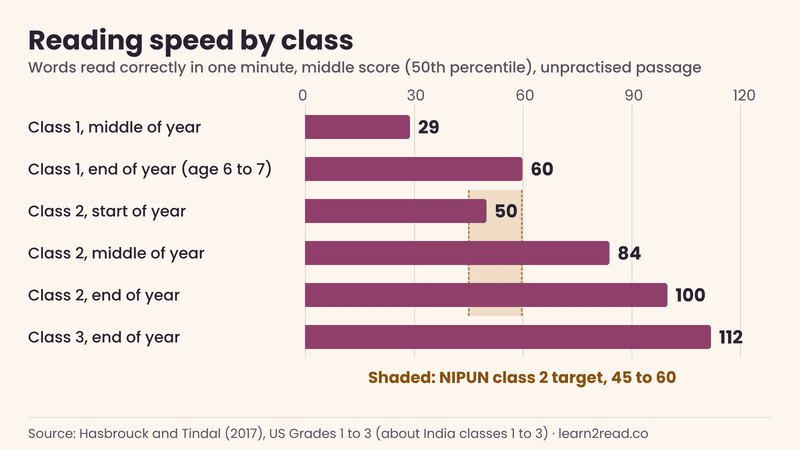
Reading speed in words correct per minute depends on the class and the time of year. Reading speed for kids rises fast across the first three years of reading, from 29 in the middle of Grade 1 to 100 by the end of Grade 2. The table shows the middle (50th percentile) score from the Hasbrouck and Tindal norms at each point in the year, with the matching class in India, the UK and the Gulf.
US grade (typical age) | India / Gulf | UK | Start of year | Middle of year | End of year |
Grade 1 (6 to 7) | Class 1 / Grade 1 | Year 2 | No norm | 29 | 60 |
Grade 2 (7 to 8) | Class 2 / Grade 2 | Year 3 | 50 | 84 | 100 |
Grade 3 (8 to 9) | Class 3 / Grade 3 | Year 4 | 83 | 97 | 112 |
Words correct per minute (WCPM), 50th percentile, reading an unpractised grade-level passage aloud for one minute. Source: Hasbrouck and Tindal (2017), Table 4. Ages and class matches are approximate, since school starting ages differ by country and by school.
In Dubai, Abu Dhabi, Doha or Riyadh, check which curriculum your child's school follows: a CBSE or Indian school uses the class row, a British curriculum school uses the Year column, and an American curriculum school uses the Grade column.
Two other benchmarks are worth knowing:
India. The NIPUN Bharat guidelines (India's national mission for foundational literacy) set a target for Grade 2 of reading with meaning at "45-60 words per minute", and for Grade 3 of "at least 60 words per minute". For Grade 1, the target is reading short sentences of at least 4 to 5 simple words in an unfamiliar text, with no speed figure.
UK. The Department for Education's Reading Framework, citing the Standards and Testing Agency, notes that around 90 words per minute is a good sign a child can "start to read with sufficient fluency to focus on their understanding." That figure is aimed at children who have finished their phonics programme, usually from Year 2 onwards, and the framework adds that some pupils read more slowly.
What Does "Words Correct Per Minute" Mean?
Words correct per minute (WCPM) is the number of words a child reads aloud correctly in one minute from a passage they haven't practised. Mistakes and skipped words don't count. It's the standard measure of oral reading fluency, which is reading accurately at a natural pace.
Reading Rockets describes the test as having students "read aloud from an unpracticed passage for one minute." Three details make a big difference to the number you get at home:
Unpractised text. A favourite book your child has read twenty times will produce a much higher score, because they partly know it by heart. Use something new at the right level.
Correct words only. Ten fast words with four mistakes is six words correct. Speed bought with errors doesn't count.
Grade-level text. A very easy book inflates the score and a hard one deflates it. Use a book or passage from your child's class reader or a levelled book for their year.
That's the single biggest gap in most advice about reading speed: the number only means something if it's measured the same way the norms were. So if another parent mentions 70 words a minute, ask which book. A favourite read many times will give a higher score than a new passage.
How to Test Your Child's Reading Speed at Home (1 Minute)
You can check your child's reading speed at home with a new passage, your phone's stopwatch and a pencil. The whole check takes about five minutes, and the reading itself takes one.
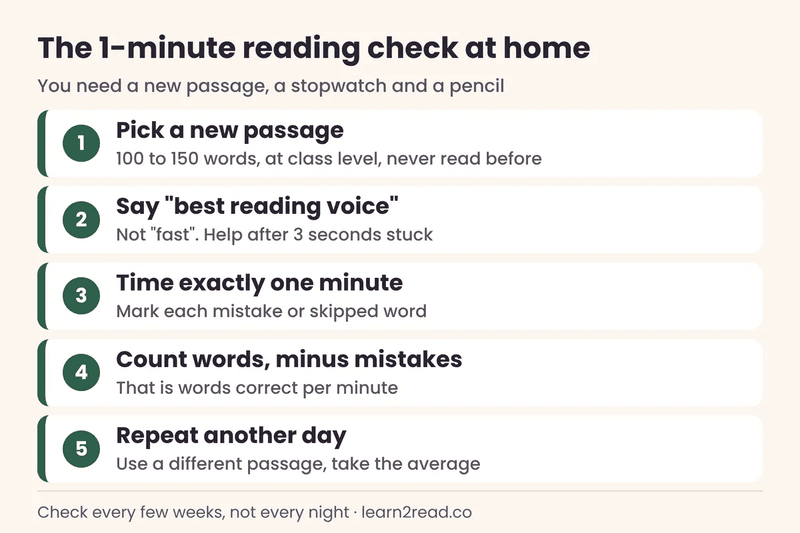
Pick a new passage of about 100 to 150 words from a book at your child's class level that they haven't read before. Make a photocopy or a photo you can mark.
Say: "Read this to me in your best reading voice. If you get stuck on a word, I'll tell you and you keep going." Don't say "fast".
Start the timer when they read the first word. Stop at exactly one minute.
Mark as they read. Put a small cross over any word they get wrong, skip, or need you to supply after about 3 seconds. Self-corrections count as correct.
Count the words read in that minute, minus the marked ones. That's the words correct per minute.
Repeat on another day with a different passage and take the average. One reading on a tired evening tells you little.
Write the score and the date down, then check it against the table above for your child's class and time of year. A single score is a snapshot. Three scores over six weeks show you which way things are moving, and that is what you actually want to know.
Is My Child a Slow Reader?
A child is reading more slowly than most children their age if their words correct per minute sits well below the middle score for their class and time of year. Reading Rockets, summarising the Hasbrouck and Tindal guidance, says children who score 10 or more words below the 50th percentile on two unpractised grade-level passages need a fluency-building programme.
Before you decide, check three things. These are usually where a low number comes from:
Is the child still sounding out many words? If most words need sounding out, the slow speed is a word-reading issue and the fix is phonics practice, not speed practice.
Is accuracy low? Many mistakes point to gaps in letter sounds or guessing. Speed will follow once the words are read correctly.
Is English a second or third language at home? Many families reading this speak Hindi, Tamil, Arabic or another language at home. A child reading in a newer language may read more slowly at first, which is a reason to keep checking progress, not a reason to panic.
The 2017 norms report also notes that children below or significantly below benchmark are "good candidates for further diagnostic assessments", which is a job for the school, not for a parent with a stopwatch.
How Can I Help My Child Read Faster?
The best-proven way to help a child read faster is to have them re-read the same short text aloud several times with a little feedback. The US National Reading Panel asked whether guided repeated oral reading improves fluency and reading achievement and reported that "the answer was a clear yes."
A simple home version, 10 minutes most days:
Warm up on yesterday's tricky words (2 minutes). Sound out and say fast the words that slowed them down last time.
Read it to them first (1 minute). Your child hears how the passage should sound, with natural pauses.
They read it (2 minutes). Help with any word they can't sound out.
They read it again (2 minutes). Point out a word that came faster the second time.
Third read, with expression (3 minutes). "Can you read it like the character would say it?" Note the words that slowed them down for tomorrow's warm-up.
Don't make speed the goal; praise smooth, correct reading.
Children who are pushed to "go faster" often start guessing, and guessing lowers the score that matters, the number of words read correctly. If your child reads every word separately, like a robot, our guide on reading words but not sentences has the next step.
How much daily reading is enough? Our guide on how many minutes a child should read a day breaks it down by age.
When Should I Ask for Help With Reading Speed?
Talk to your child's class teacher if their reading speed stays well below the middle score for their class across a few months of regular practice, or if they're still sounding out most common words by the end of class 1. Bring your dated scores to the next PTM (parent-teacher meeting). Our list of questions to ask your child's teacher about reading helps you use that meeting well.
Usually fine | Worth raising with the teacher |
Below 29 WCPM in the middle of class 1, but rising each month | Below the class middle score, with no change over two or three months |
Reads slowly but accurately | Many mistakes even on easy text |
Faster on the second read of a passage | No faster on the second or third read |
Slower in English than in the home language at first | Struggles to read in every language they're taught |
Slow, effortful reading can have several causes, from too little practice to hearing or vision problems or dyslexia. Ask your paediatrician to check hearing and eyesight, and see our guide to the early signs of dyslexia for what else to watch for between 4 and 7. A words-per-minute score on its own never diagnoses anything.
FAQs
How many words per minute should a 6 year old read?
A typical 6-year-old in Grade 1 (class 1 in India, Year 2 in the UK) reads about 29 words correct per minute in the middle of the year and about 60 by the end, on an unpractised passage, according to the Hasbrouck and Tindal 2017 norms. The middle half of children read between about 34 and 91 words correct per minute at the end of Grade 1.
What reading speed is normal for class 1 in India?
India's NIPUN Bharat guidelines set no speed target for Grade 1. They expect a child to read short sentences of at least 4 to 5 simple words in an unfamiliar text. Speed targets start in Grade 2, at 45 to 60 words per minute with meaning, rising to at least 60 words per minute in Grade 3.
What is WCPM in reading?
WCPM stands for words correct per minute. It's the number of words a child reads aloud correctly in one minute from a passage they haven't practised before, with mistakes and skipped words subtracted. Schools use it as a quick measure of reading fluency.
How do I test my child's reading speed at home?
Choose a new passage of 100 to 150 words at your child's class level, ask them to read it aloud in their normal reading voice, and time one minute. Count the words read, subtract any mistakes or skipped words, and repeat with a different passage on another day. The average of the two is the most useful number.
Does reading speed matter more than accuracy?
No. Accuracy comes first, because speed built on guessing falls apart on harder text. Words correct per minute only counts words read correctly, so a child who reads carefully and correctly is building the base that speed grows from.
How many words per minute should a 6 year old read in the UK?
In the UK, most 6-year-olds are in Year 1 or Year 2. Year 1 children are usually still learning to decode, so speed isn't a useful measure yet. By the end of Year 2 (US Grade 1 age), the Hasbrouck and Tindal norms put a typical reader at about 60 words correct per minute. The Standards and Testing Agency, quoted in the Department for Education's Reading Framework, treats around 90 words per minute as the point where a child can start to read fluently enough to focus on understanding, usually later in Year 2 or beyond, and some children understand well while reading more slowly.
Is my child slow if they read 30 words a minute?
Not necessarily. About 30 words correct per minute is close to the middle score for the middle of Grade 1 (class 1). The same score at the end of Grade 2 would be well below the middle and worth discussing with the class teacher. The class and time of year decide what a score means.
How can I improve my child's reading fluency?
Have your child re-read the same short passage aloud three times in one session, after hearing you read it first. The US National Reading Panel found guided repeated oral reading improves fluency. Ten minutes most days, with praise for smooth, correct reading, works better than timing your child or asking them to read faster.
How many words per minute should a 7 year old read?
A typical 7-year-old in Grade 2 (class 2 in India) reads about 50 words correct per minute at the start of the year, 84 in the middle and 100 by the end, according to the Hasbrouck and Tindal 2017 norms. India's NIPUN Bharat target for Grade 2 is 45 to 60 words per minute with meaning.
Read Next
Child Can Read Words but Not Sentences? Fix Choppy Reading: what to do when reading is accurate but slow and word by word.
How Many Minutes Should a Child Read a Day? Guide by Age: how much daily practice builds speed.
Reading Milestones by Age: What Your Child Should Do at 3, 4, 5, 6 and 7: the wider picture beyond reading speed.
So, how many words per minute should a 6 year old read? Somewhere around 29 in the middle of class 1 and 60 by the end, measured fairly, with plenty of normal variation. Keep the stopwatch for a check every few weeks and spend the rest of the time re-reading. If you'd like a teacher to help your child read more smoothly, book a free trial class with Learn2Read, a live online phonics programme for children aged 3 to 12.

Latest Posts

14 November 2026
How Many Words Per Minute Should a 6 Year Old Read? (2026)
11 November 2026
When Do Kids Stop Sounding Out Words? UKG to Class 2 Guide

7 November 2026
Child Refuses to Read at Home? Check the Book First, Age 4-8

A new chapter from Learn2Read
Read Before They Read
Before you teach your child to read, read this. A calmer, clearer way into your child’s reading journey—with a practical guide written for real Indian homes.