21 November 2026
How to Pronounce Phonics Sounds in English: a to z Guide
How to Pronounce Phonics Sounds in English: a to z Guide
posted on : 21 November 2026
By Nitin Jain, Founder, Learn2Read · Published 21 November 2026
Nitin Jain founded Learn2Read, which teaches live online phonics classes to children aged 3 to 12. Checked against the UK Department for Education's Letters and Sounds programme, Oxford Owl's phonics guidance, Reading Universe (WETA) and the US National Center on Improving Literacy. Last reviewed: 21 November 2026.
You've been practising sounds with your child every evening, but nobody showed you how to pronounce phonics sounds. "buh, a, tuh."
Then the teacher says, kindly, that your child is adding an "uh" to every sound. Most adults learnt sounds this way, so it's an easy habit to pass on and an easy one to fix.
You're in good company. One Mumsnet mother, whose son had just started school, wrote that she was "not happy for him to be re-learning it 'wrong', after having carefully always said mmm and sss and fff". A reception teacher replied: "I know how important it is to not add the 'uh' to sounds!"
Here's how to pronounce phonics sounds correctly: say each one as a pure sound, short and clean, with nothing added at the end. Sounds you can hold, like m and s, you stretch ("mmm", "sss"). Sounds you can't hold, like b and t, you say in one quick bounce, and you whisper the ones that don't use your voice.
This guide gives you the reason it matters, a full a to z sound guide, the sounds Indian-English speakers often mix up, and a five-minute routine. It's written for parents of children in LKG, UKG and class 1 in India, KG1 and KG2 in the Gulf, and nursery or reception elsewhere.
In this guide:
Why the extra "uh" matters · Stretchy and bouncy sounds · How to pronounce phonics sounds a to z · Sounds Indian-English speakers mix up · A 5-minute routine · If your child already says "buh"
Why Does Adding "uh" to Phonics Sounds Matter?
Adding "uh" to phonics sounds matters because the extra sound gets in the way of blending. When a child says "cuh, a, tuh" and pushes the sounds together, they hear "cuh-a-tuh", which isn't a word. When they say a short "c", "a", "t", the sounds join straight into "cat".
The UK Department for Education's phonics programme, Letters and Sounds, is direct about it: "Do not add an 'uh' to the end of sounds: 'ssss' not 'suh', 'mmm' not 'muh', 't' not 'tuh', 'sh' not 'shuh'".
Oxford Owl, the parent site from Oxford University Press, explains why. Its guide to the Read Write Inc. phonics programme says: "We say 'mmmm' not 'muh' and 'lllll' not 'luh' when teaching the sounds. This really helps children when they learn to blend sounds together to read words."
Most of us add the "uh" because it's how we learnt. It feels clearer, especially for a quick sound like b.
The cost shows up later, when your child sits with a word and can't make the sounds turn into it. Our guide on how to teach blending covers that stage in detail.
What Are Stretchy and Bouncy Sounds in Phonics?
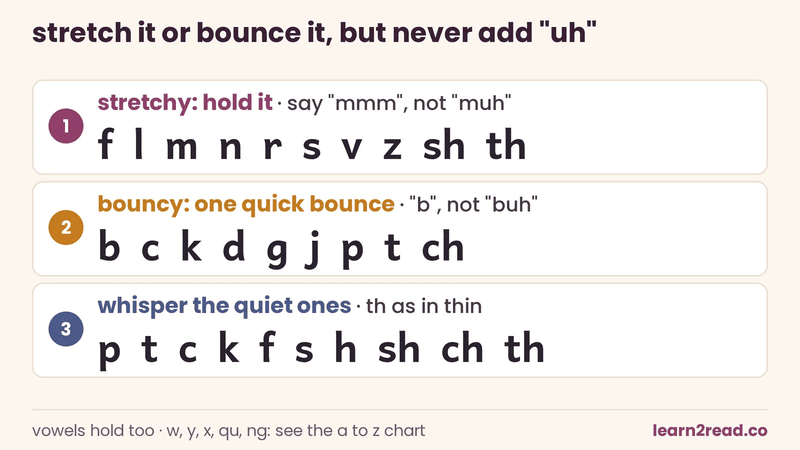
Stretchy sounds are sounds you can hold for as long as your breath lasts, like "mmm", "sss" and "fff". Bouncy sounds are quick sounds you can't hold without adding "uh", like b, t and p. Many phonics programmes use these two names, and knowing which is which tells you how to say each one.
Reading Universe, a teaching site from US public broadcaster WETA, calls them continuous and stop sounds. Its teaching guide explains that you can draw out a continuous sound "until you run out of breath", while a stop sound "has a quick stop after it is produced."
The US National Center on Improving Literacy adds a practical tip. "Continuous sounds are easier to hold and blend together when students are first learning to blend sounds and read words." That's why first blending words like "man", "sun" and "fan" are easier than "bat" or "dig".
|
Stretchy sounds |
Bouncy sounds | |
|
How to say them |
Hold them: "mmm", "sss" |
One short, quick bounce |
|
Consonants |
f, l, m, n, r, s, v, z, sh, th |
b, c, k, d, g, j, p, t, ch |
|
The common mistake |
"muh", "suh", "fuh" |
"buh", "tuh", "duh" with a big "uh" |
|
Tip |
Hold it for two seconds |
Keep your mouth almost closed after the sound |
The short vowel sounds (a as in ant, e as in egg, i as in ink, o as in on, u as in up) can be held too. Programmes differ on where to put h, w and y. Say all three short and light.
A second tip helps with every sound. Some sounds use your voice and some are only breath. Put your child's hand on your throat and say "zzz", then "sss", and they'll feel a buzz for z and nothing for s.
Letters and Sounds tells teachers to "take care to whisper when modelling quiet sounds". Quiet sounds are the ones made with breath only, like p, t, c, k, f, s, h, sh, ch and th (as in thin), so whisper those. A whispered "t" has no room for an "uh".
How to Pronounce Phonics Sounds from a to z
Knowing how to pronounce phonics sounds correctly comes down to one habit: say each letter's sound as it is heard inside a word, with no "uh" after it. Vowels use their short sound, as in the first sound of ant, egg, ink, on and up. Here is phonics sounds pronunciation a to z, set out as a phonics sound chart you can screenshot.
|
letter |
how to say it |
type |
key word |
the mistake to avoid |
|
a |
a, as in ant |
stretchy |
ant |
"ay" (the letter name) |
|
b |
b, lips pop, no "uh" |
bouncy |
bat |
"buh" |
|
c |
k, whispered |
bouncy |
cat |
"kuh" or "see" |
|
d |
d, short |
bouncy |
dog |
"duh" |
|
e |
e, as in egg |
stretchy |
egg |
"ee" |
|
f |
fff, whispered |
stretchy |
fan |
"fuh" |
|
g |
g, as in goat |
bouncy |
goat |
"guh" or "jee" |
|
h |
a soft breath, h |
short |
hat |
"huh" or "aitch" |
|
i |
i, as in ink |
stretchy |
ink |
"eye" |
|
j |
j, short |
bouncy |
jam |
"juh" |
|
k |
k, whispered (same as c) |
bouncy |
kit |
"kuh" |
|
l |
lll |
stretchy |
leg |
"luh" |
|
m |
mmm |
stretchy |
man |
"muh" |
|
n |
nnn |
stretchy |
net |
"nuh" |
|
o |
o, as in on |
stretchy |
on |
"oh" |
|
p |
p, a whispered puff |
bouncy |
pan |
"puh" |
|
q |
kw (q and u go together) |
bouncy |
queen |
"kyoo" |
|
r |
rrr, not rolled |
stretchy |
rat |
"ruh" |
|
s |
sss, whispered |
stretchy |
sun |
"suh" |
|
t |
t, whispered |
bouncy |
tap |
"tuh" |
|
u |
u, as in up |
stretchy |
up |
"yoo" |
|
v |
vvv, top teeth on bottom lip |
stretchy |
van |
"vuh", or saying it like w |
|
w |
w, lips in a small circle |
short |
web |
"wuh", or saying it like v |
|
x |
ks |
bouncy |
box |
"eks" |
|
y |
y, as in yes |
short |
yes |
"yuh" or "why" |
|
z |
zzz |
stretchy |
zip |
"zuh" |
Two letters behave differently. Reading Universe calls q and x "outliers" because each is "articulated with two sounds": q with u says "kw", and x says "ks". Teach x with a word where it comes at the end, like box or fox, because that's where children hear the "ks" clearly.
The same no-"uh" rule applies to two-letter sounds: "sh" (ship), "ch" (chip), "th" (thin), "ng" (ring), "qu" (queen). Oxford Owl says English has "44 phonics sounds, or phonemes", and all 44 phonemes are said clean, with no "uh".
If your child still answers with letter names ("ay, bee, see"), our guide on letter names vs letter sounds explains how to switch them over without confusion.
Which Phonics Sounds Do Indian-English Speakers Often Mix Up?
The phonics sounds Indian-English speakers most often mix up are v and w, z and j, and the "th" sound. These are normal features of Indian English and nothing to feel bad about. They matter in phonics only because a child has to hear the difference to spell words like "vet" and "wet".
Wikipedia's article on Indian English notes that for many speakers "wet and vet are often homophones" (they sound the same), that "most major native languages of India lack the dental fricatives" (the "th" sound), and that t and d "are often retroflex", said with the tongue curled back, "especially in the north of India." It also notes that many speakers use a "j" sound for z, so "zero" sounds like "jero", and that some say f more like "ph". The curled t and d don't change spelling, so you can leave those alone.
|
Sound |
What often happens |
How to say it for phonics |
|
v |
Said like w, or halfway between |
Top teeth gently on the bottom lip, then buzz: "vvv" |
|
w |
Said like v |
Round your lips into a small circle, no teeth: a quick "w" |
|
th (thin) |
Said like a hard t |
Tongue tip between the teeth, blow softly |
|
z |
Said like j ("jero" for zero) |
Teeth close together, buzz like a bee: "zzz" |
|
th (this) |
Said like d ("dis") |
Tongue tip between the teeth, then buzz: "th-is" |
|
f |
Said like a p with a puff of air |
Top teeth on the bottom lip, blow: "fff" |
You don't need to change how you speak. Use a mirror for these sounds, and let your child copy your mouth. For v, your top teeth rest on your bottom lip; for w, your teeth never touch your lip.
How to Practise Phonics Sounds at Home in 5 Minutes
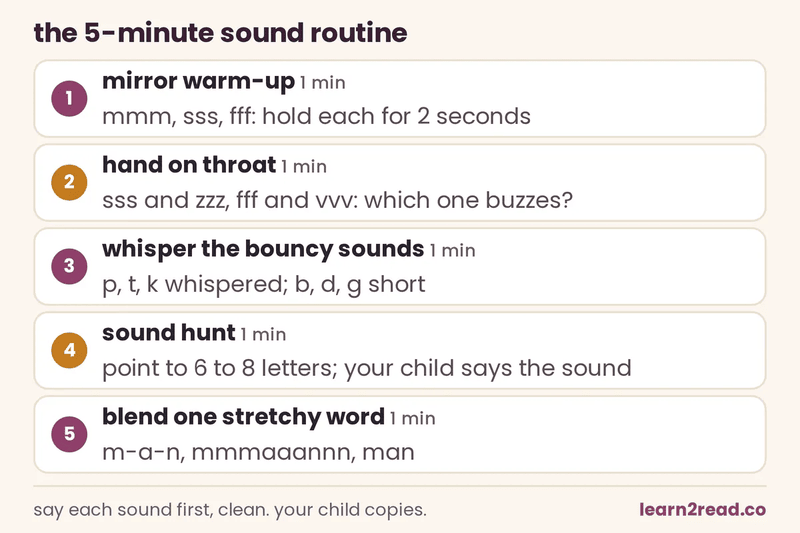
Five minutes of daily sound practice, with you saying each sound clean first, is enough for most LKG and UKG children, and it's the easiest way to learn how to say letter sounds correctly alongside them. Short and often works better than a long session once a week.
-
Warm up in the mirror (1 minute). Sit side by side facing a mirror. Say three stretchy sounds together, "mmm", "sss", "fff", holding each for two seconds.
-
Hand on throat (1 minute). Say pairs that differ only in voice: "sss" and "zzz", "fff" and "vvv". Your child feels which one buzzes.
-
Whisper the bouncy sounds (1 minute). Whisper "p", "t", "k". Then say "b", "d", "g" short, with your mouth almost closed after each.
-
Sound hunt (1 minute). Point to 6 to 8 letters on a card at random. Your child says the sound. If they add "uh", say the sound back cleanly and let them copy you, without making a big deal of it.
-
Blend one stretchy word (1 minute). Try "m-a-n", holding each sound into the next: "mmmaaannn", then "man". Then "sun" and "fan". These are easier than "bat" because nothing has to bounce.
For extra practice ideas, our guide for a child who keeps forgetting letter sounds has a daily review routine that works well alongside this one.
My Child Already Says "buh" and "tuh". Can I Fix It?
Yes, and it's worth doing, because "buh-a-tuh" won't blend into "bat". This section shows how to undo the habit. Children who learnt sounds with an "uh" can switch at any age when they hear clean sounds modelled every day.
Don't stop your child every time they add an "uh". Constant correction makes sound practice feel like a test, and children who feel tested start to avoid it.
Instead, repeat the sound back the clean way, as if you're agreeing: "Yes, t." Do the same at blending time, where it matters most.
Start with the stretchy sounds, because "mmm" and "sss" are easy to hear and easy to copy. Bouncy sounds take longer.
A child who says a slightly long "b" is fine. The aim is a clean bounce with no added "uh", and getting close is good enough for blending.
Some sounds, especially th and r, are hard for many young children to say clearly, so don't push a four year old on them. If you're worried about your child's speech, ask your paediatrician about a speech and language check.
If your child's school teaches sounds with songs or actions, such as Jolly Phonics, and you hear an "uh" in them, talk to the teacher at the next PTM (parent-teacher meeting). The teacher will know which version they want at home. If you're comparing programmes, our guide on how to choose a phonics program lists clean sounds as one thing to check.
FAQs
How do you pronounce phonics sounds correctly?
Pronounce each phonics sound short and clean, with no "uh" added at the end. Hold the stretchy sounds, like "mmm" and "sss", and say the bouncy sounds, like b and t, in one quick bounce. Vowels use their short sounds, as in ant, egg, ink, on and up.
Why should I say "mmm" and not "muh"?
Saying "mmm" keeps the sound pure, so it joins smoothly to the next sound when a child blends. An extra "uh" turns "c-a-t" into "cuh-a-tuh", which doesn't sound like "cat". Both the UK Department for Education and Oxford Owl advise against adding "uh" to sounds.
What is the difference between stretchy and bouncy sounds?
Stretchy sounds, like m, s, f and l, can be held for as long as your breath lasts. Bouncy sounds, like b, t, p and d, are quick and can't be held without adding "uh". First blending words are easier with stretchy sounds, such as "man" and "sun".
How do you say the letter x in phonics?
In phonics, the letter x is said "ks", which is two sounds together. It's easiest to teach with words where x comes at the end, like box, fox and six, because the "ks" is clearest there. Avoid saying the letter name "eks" during sound practice.
How do you say the letter q in phonics?
In English, q almost always comes with u, and together they say "kw", as in queen and quick. Many phonics programmes teach "qu" as one sound card. Avoid saying "kyoo", which is the letter name.
My child learnt sounds with "uh". Is it too late to fix?
No. Children can switch to clean sounds at any age if the adults around them model clean sounds every day. To help, repeat sounds back the clean way without stopping the child each time, and start with stretchy sounds like "mmm" and "sss".
Can I explain phonics sounds in Hindi?
Yes. Explaining in Hindi is fine, and it can help. Hindi letters like म and स carry a built-in "a" sound (ma, sa), which is exactly the extra sound to drop, so say just the "mmm" of म.
How do you pronounce Jolly Phonics sounds?
Say Jolly Phonics sounds the same way as any phonics sound: short and clean, with no "uh". The songs and actions help children remember, but the sound itself stays "sss", not "suh".
How do you say u and y in phonics?
In phonics, u says the short sound at the start of up, not "yoo". The letter y says the first sound in yes, short and light, not "why".
How many phonics sounds are there in English?
English has about 44 phonics sounds, or phonemes. Children start with the single-letter sounds, then learn two-letter sounds like sh, ch, th and ng, and later long vowel sounds. Each of these is said cleanly, with no "uh" at the end.
Read Next
-
My Child Knows the Alphabet (ABCD) but Can't Read: Letter Names vs Letter Sounds: if your child answers with "ay, bee, see" instead of sounds.
-
How to Teach Blending: When Your Child Knows the Sounds but Can't Read the Word: the next step, once the sounds are clean.
-
Child Keeps Forgetting Letter Sounds? How to Make Them Stick: for sounds that are said right one day and gone the next.
Learning how to pronounce phonics sounds is a small change for you that makes blending easier for your child. Say them short, say them clean, and stretch the ones that stretch. If you'd like a teacher to model every sound for your child and take them on to reading words, book a free trial class with Learn2Read, a live online phonics programme for children aged 3 to 12.

Latest Posts
18 November 2026
How to Teach Magic e: Rule, Word Lists & Games for Class 1
14 November 2026
How Many Words Per Minute Should a 6 Year Old Read? (2026)
11 November 2026
When Do Kids Stop Sounding Out Words? UKG to Class 2 Guide

A new chapter from Learn2Read
Read Before They Read
Before you teach your child to read, read this. A calmer, clearer way into your child’s reading journey—with a practical guide written for real Indian homes.