7 October 2026
How to Teach Blending: When Your Child Knows the Sounds but Can't Read the Word
How to Teach Blending: When Your Child Knows the Sounds but Can't Read the Word
posted on : 19 September 2026
Your child knows every sound. Ask for /c/, they give you /c/. Ask for /a/, no problem. Then you point at cat and they say "c... a... t..." and stop. Three correct sounds, no word.
This is the most common wall in early reading, and it isn't a sign that anything is wrong. Blending is a separate skill from knowing sounds, it has to be taught on its own, and most children need a few weeks of very short practice before it clicks. This guide gives you the technique that works (stretching instead of chopping), the order to practise words in, and what to do on the days it falls apart.
The fix is usually one small change in how the sounds come out of your mouth.
Why Can't My Child Blend Sounds?
Because the first sound is gone by the time they reach the last one. Blending isn't really a mouth problem, it's a memory problem.
Picture what your child is doing. They say /c/. Then they have to find the sound for a, which takes a second or two of thinking, so they say /a/. Then they hunt for /t/. By the time /t/ arrives, /c/ was four seconds ago and has faded. There's nothing left to blend. They aren't holding three sounds, they're producing three separate events.
That's why the standard advice makes it worse. When we chop the sounds hard, "c! a! t!", we're building three separate events on purpose, with silence between them. The silence is where the word gets lost.
There's a second reason worth checking, and it's quick to rule out. Some children add a vowel to consonant sounds without realising: they say "cuh" instead of /c/, "tuh" instead of /t/. Then cat comes out as "cuh-a-tuh", which genuinely does not sound like cat, and no amount of blending practice will rescue it. Say the sounds crisply yourself and see whether your child copies. Our phonics sound chart has all 44 sounds if you want to check how a few of them should sound.
Stretch the Word, Don't Chop It
Say the word slowly without stopping between the sounds. This one change fixes blending for most children.
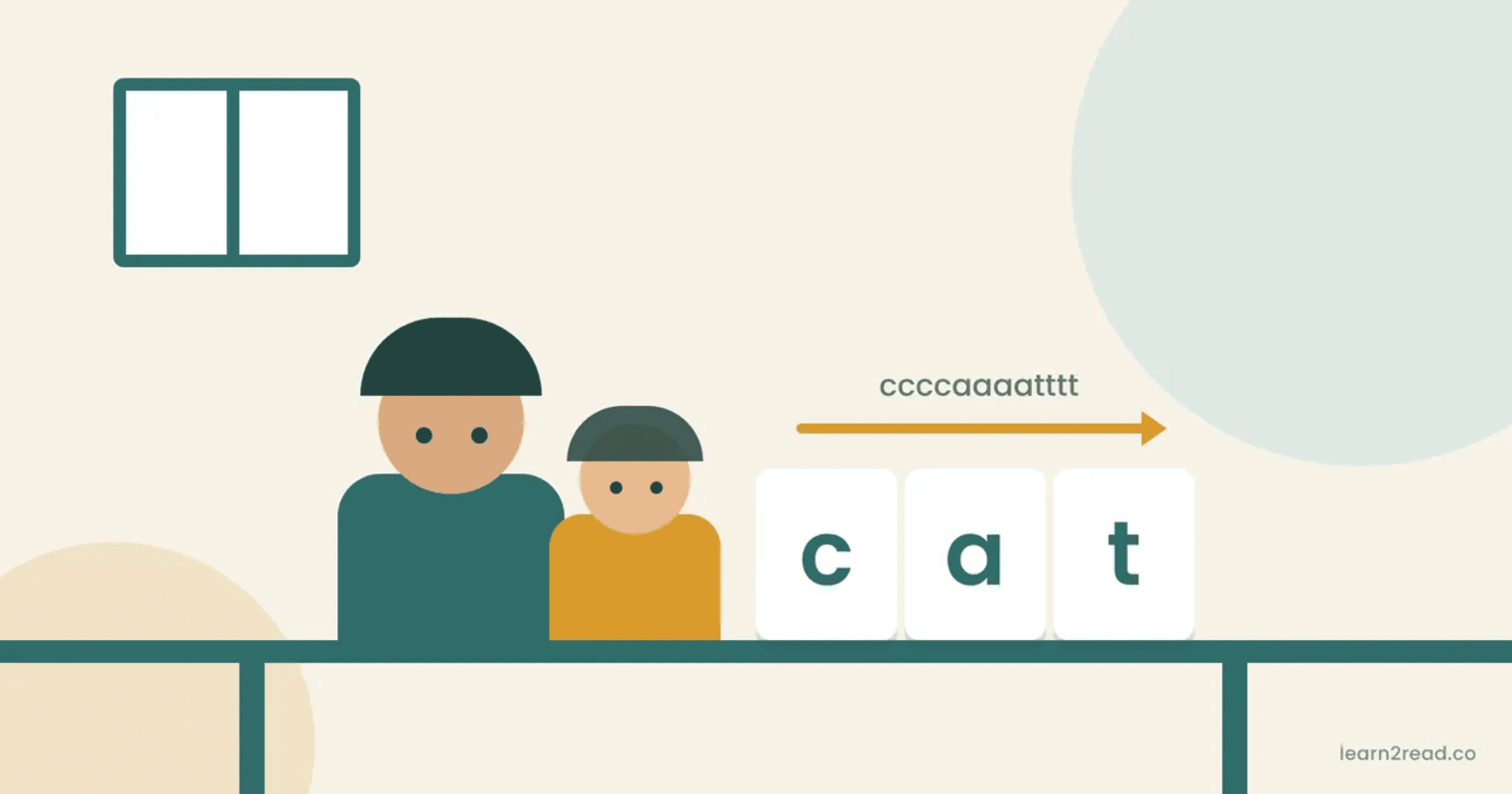
Instead of "c! a! t!" try "ccccaaaatttt", holding each sound until the next one starts, so there's never a gap. This is called continuous blending, and it works because your child never has to hold anything in memory. The sounds arrive as one continuous stream, and a stream is already a word being spoken slowly.
Try it right now with your own voice. "ccccaaaatttt" sounds like cat said slowly. "c. a. t." doesn't sound like anything.
Some sounds can't be stretched, and that's fine. You can hold /s/, /m/, /f/, /n/, /l/ and most vowels for as long as you like. You can't hold /t/, /p/, /k/, /b/ or /d/, because they're made by stopping the air. For a word like pot, stretch what you can and keep the stop sounds tight against their neighbour: "p-oooooot". Do not let a gap open up after the /p/.
Reading Rockets suggests a useful habit for shared reading: "sound out some of the words before you say them completely" as you read together. Your child hears the stream and then the word, over and over, without being tested on anything.
Start With Two Sounds, Not Three
Almost every blending programme starts at three sounds, and that's one sound too many for a child who is stuck.
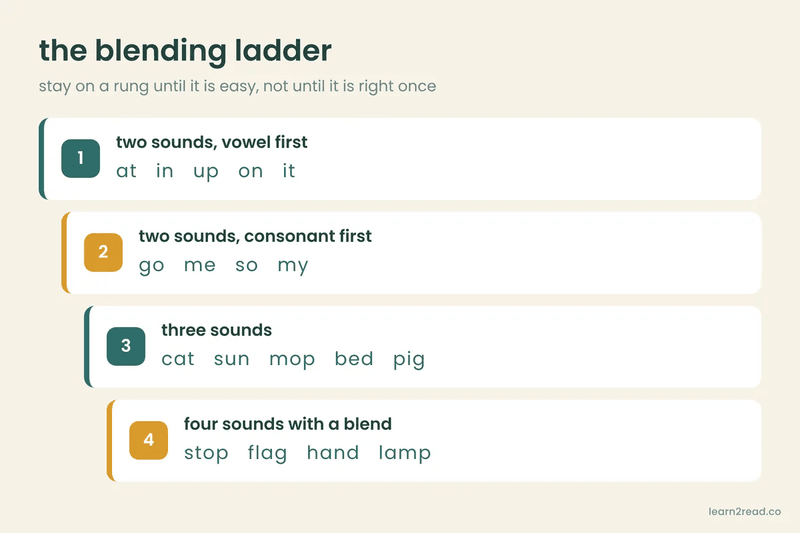
Work up this ladder. Stay on a rung until it's easy, not until it's correct once.
Rung | Word shape | Words to use | Why it comes here |
1 | two sounds, vowel first | at, in, up, on, it | nothing to hold. your child blends two things, not three |
2 | two sounds, consonant first | go, me, so, my | introduces starting with a consonant, still only two sounds |
3 | three sounds | cat, sun, mop, bed, pig | the real target. most children stall here without rungs 1 and 2 |
4 | four sounds with a blend | stop, flag, hand, lamp | two consonants together, the next genuine jump |
Rung 1 is the one people skip, and it's the one that usually makes the rest click. A child who can blend /a/ /t/ into at has understood the whole idea. After that, cat is the same trick with one more sound on the front.
A quiet trick for rung 3: build words from a word your child already owns. If at is solid, then cat, mat, sat and fat are all "add one sound to the front of at." That's much easier than assembling three sounds from nothing.
Give the Sounds Somewhere to Live
Young children hold sounds better when the sounds have a physical place. Reading Rockets recommends having your child "sound out the name while placing marbles, drawing marks, or tapping their fingers for each of the individual sounds."
Three that work well at home:
Fingers. One finger per sound as you say it, then sweep your hand left to right as you say the whole word. The sweep is the important half. It tells your child's body that the separate things become one thing.
Buttons or coins. One object per sound, laid left to right. Push them together as you blend. Children who resist worksheets will often do this happily because it looks like a game rather than reading.
The arm slide. Touch your shoulder for the first sound, your elbow for the second, your wrist for the third, then slide your hand down the whole arm as you say the word. Big movements suit children who can't sit still, which is most five-year-olds at the end of a school day.
Pick one and keep it. Switching between them every night means your child learns three systems instead of one skill.
What to Do When It Falls Apart
Blending is inconsistent for weeks before it's reliable. A child who blends four words beautifully and then can't do the fifth hasn't forgotten anything, they've run out of concentration. Five minutes is a full session at this age.
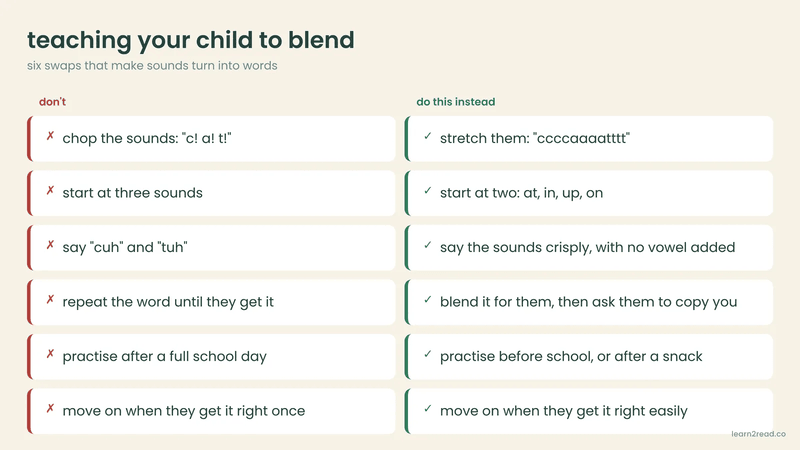
❌ Don't | ✅ Do instead |
chop the sounds: "c! a! t!" | stretch them: "ccccaaaatttt" |
start at three sounds | start at two: at, in, up, on |
say "cuh" and "tuh" | say /c/ and /t/ crisply, with no vowel added |
repeat the word until they get it | blend it for them, then ask them to copy you |
practise after a full school day | practise before school, or after a snack |
move on when they get it right once | move on when they get it right easily |
The fourth row is the one that changes the most homes. When a child is stuck, we tend to repeat the question louder and slower. That produces a child who feels tested and a parent who feels ignored. Modelling costs nothing: say the whole blended word yourself, ask them to say it after you, and move on. Copying is how this skill transfers.
How Long Should This Take?
A few weeks of very short sessions, not months of long ones. Five minutes, four or five days a week, beats twenty minutes on a Sunday.
The National Reading Panel, the largest review of reading research commissioned in the US, found that "explicitly and systematically teaching children to manipulate phonemes significantly improves children's reading and spelling abilities." The two words doing the work there are explicitly and systematically. Blending doesn't arrive by reading more books. It arrives because someone taught it on purpose, in order, for a short time every day.
Once blending works, something else starts happening on its own. Each time your child successfully decodes a word, they store it, and Reading Rockets calls that storage orthographic mapping, "the process of storing a word permanently in memory for instant retrieval." Reading scientist Timothy Shanahan describes where that road ends: "If decoding is taught well and effectively students eventually recognize almost all words as sight words." Blending is what feeds that. It's temporary scaffolding that builds something permanent.
Give your child books they can actually decode while this is happening. Decodable books use only sounds your child has already met, so blending practice happens inside real sentences rather than on a word list. And if your child has started covering the gap by reading the pictures instead, that habit needs its own fix: why children guess at words has the four-week routine.
When Blending Trouble Means Something More
Most blending difficulty clears with a few weeks of stretched sounds and a two-sound starting point. Speak to your child's teacher, and then your doctor, if you see:
a child of six or older who still can't blend two sounds after several weeks of daily practice
difficulty hearing sounds in spoken words with no letters involved at all, for instance not being able to tell you the first sound in sun
blending that works one minute and vanishes the next, over months rather than weeks
a child who can blend on Monday's words but never on a word they haven't practised
real distress at the sight of letters, or complaints of headaches during reading
None of this means something is wrong for certain. It means it's worth a proper look rather than more practice at home, and early is always kinder than later. Our reading milestones by age guide shows what's typical at each stage.
Frequently Asked Questions
Why can my child say all the sounds but not read the word?
Because blending is a separate skill from knowing letter sounds, and it depends on holding the sounds in memory long enough to join them. By the time a child has found the third sound, the first has usually faded. The fix is to stretch the sounds into one continuous stream, "ccccaaaatttt", so there is no gap for the word to fall through, and to start with two-sound words rather than three.
What is continuous blending?
Continuous blending means saying a word slowly without stopping between the sounds, holding each one until the next begins. It works because the child never has to store separate sounds and recombine them. Stop sounds like /t/ and /p/ cannot be held, so keep them tight against the neighbouring sound instead of leaving a pause.
What age should a child be able to blend sounds?
Most children blend simple three-sound words somewhere between ages five and six, once they know a good number of letter sounds. It varies widely and school systems start at different ages. What matters more than the age is the direction of travel: a child who is slowly getting better week by week is fine, whichever age they started.
Should I use letter cards or just say the sounds out loud?
Start with your voice only, no letters. Blending is a listening skill first. Once your child can hear /c/ /a/ /t/ and tell you it is cat with no letters in front of them, add the printed word. Putting letters in too early turns one hard task into two.
My child blends the word then forgets it two lines later. Is that normal?
Yes, and it is expected early on. A word becomes instantly recognisable only after being decoded correctly several times, so the early repetitions feel wasted but are doing the work. If a word keeps failing after many exposures, teach that word specifically by mapping its sounds rather than by repeating it.
How long should each practice session be?
About five minutes, four or five days a week. Blending demands concentration, and young children run out of it quickly. Short daily sessions build the skill faster than one long weekend session, and they keep reading from becoming something your child dreads.
My child says "cuh-a-tuh" instead of /c/ /a/ /t/. Does that matter?
It matters a lot, and it is common. Adding a vowel to consonant sounds means the blended result does not sound like the real word, so your child is trying to blend something that will never work. Model the crisp sound yourself, keep it short, and have your child copy you before going back to blending.
Read Next
Why Your Child Guesses at Words (and How to Stop It): what to do if your child has started reading the pictures instead of the letters.
Decodable Books: A Parent's Complete Guide (Ages 4-7): books built from the sounds your child already knows, so blending practice happens in real sentences.
Phonics Sound Chart for Kids: All 44 Sounds with Examples: the printable chart for checking how each sound should be said.
__________________________________________________
Five minutes a day, stretched not chopped, starting at two sounds. That's the whole method. If you'd like a trained teacher working through it alongside you, Learn2Read, a live online phonics program for children aged 3 to 12, teaches sounds and blending in a structured order so nothing gets skipped.

Latest Posts
3 October 2026
Early Signs of Dyslexia in Children: Ages 4 to 7, and 5 Things That Look Like It
30 September 2026
My Child Can Read But Doesn't Understand: Why It Happens and How to Fix It (Ages 5 to 8)
26 September 2026