18 November 2026
How to Teach Magic e: Rule, Word Lists & Games for Class 1
How to Teach Magic e: Rule, Word Lists & Games for Class 1
posted on : 18 November 2026
By Nitin Jain, Founder, Learn2Read · Published 18 November 2026
Nitin Jain founded Learn2Read, which teaches live online phonics classes to children aged 3 to 12. Checked against Reading Universe (WETA), the UK government's 2007 Letters and Sounds guidance, Little Wandle's teaching guidance and the Education Endowment Foundation. Last reviewed: 18 November 2026.
Your child reads "cap" without a pause. Then the next page says "cape", and out comes "cap-ee".
That's the moment most parents start searching for how to teach magic e. In India, "magic e words for class 1" and "silent e words for class 1" both appear in Google's autocomplete (checked November 2026). UK parents on Mumsnet have asked it too, in a thread titled "Does anyone know the 'proper' way to explain 'magic e' in phonics?"
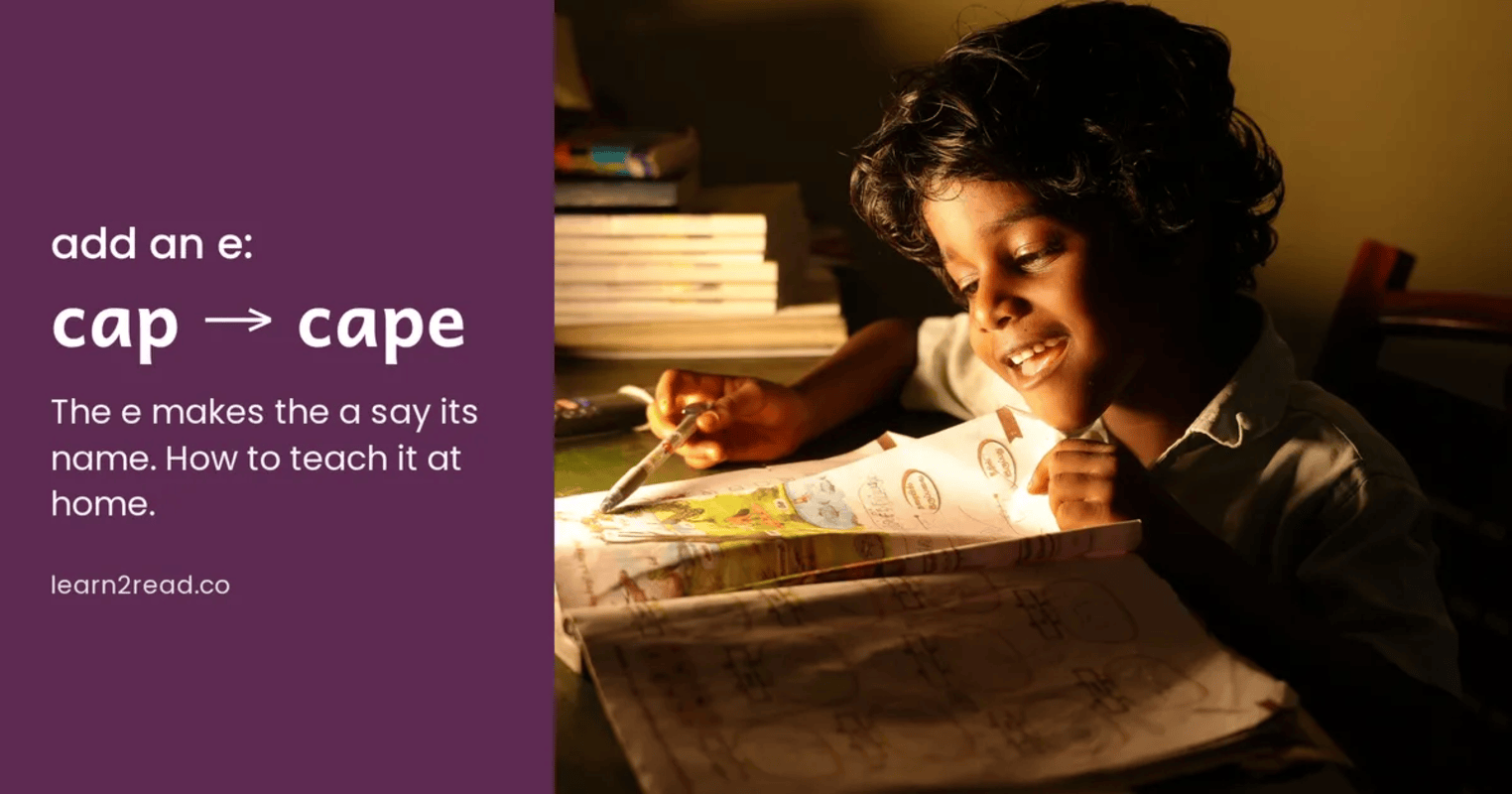
The short answer: an e at the end of a short word, with one consonant before it, usually makes the vowel before that consonant say its name. So "cap" becomes "cape" and "kit" becomes "kite". You teach it by showing your child the same word with and without the e, side by side, until they can switch between the two sounds by themselves.
Below you'll find when children are ready for magic e, a step-by-step way to teach it at home, word lists by vowel, the words that break the rule, and four games. It's written for parents of children in UKG and class 1 in India, KG2 and Grade 1 in the Gulf, and Year 1 or first grade elsewhere.
In this guide:
What is the magic e rule? · When is a child ready? · How to teach magic e in 5 steps · Magic e word lists · Words that break the rule · 4 magic e games · Common mistakes
What Is the Magic e Rule?
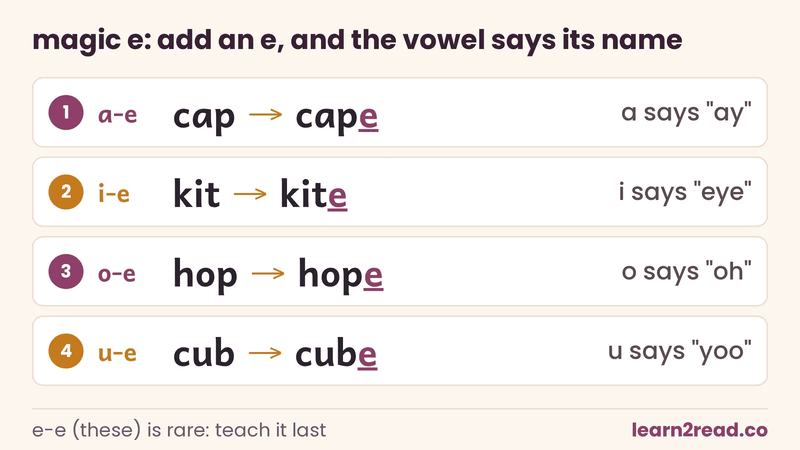
The magic e rule says that when a word ends in a vowel, one consonant and then an e, the first vowel usually says its long sound (its letter name) and the e stays silent. "cap" becomes "cape", "pin" becomes "pine" and "hop" becomes "hope".
You'll hear three names for this pattern. Most children hear it called "magic e".
The name "silent e" says what the e does out loud, which is nothing. "Split digraph" is the term UK schools use, because the vowel and the e work as a pair of letters with one consonant splitting them.
Reading Universe, a teaching site from US public broadcaster WETA, explains that a magic e word has a "vowel-consonant-e (VCe) pattern", and that spotting it "tells you that the first vowel says its long sound."
Parents asking how to teach magic e often get stuck on which name is "proper". Use the name your child's school uses, so home and school match. For a five year old, "the e makes the vowel say its name" is the clearest way to explain it, whatever it's called.
Here is the one idea that makes the rule click for most children. The e doesn't make a sound of its own. Its whole job is to change the sound of the vowel two places to its left.
There are five magic e pairs to learn:
Pattern | Short vowel word | Add e | The vowel now says |
a-e | cap | cape | "ay", as in the letter name a |
i-e | kit | kite | "eye", as in the letter name i |
o-e | hop | hope | "oh", as in the letter name o |
u-e | cub | cube | "yoo", as in cube (sometimes "oo", as in tune) |
e-e | (no common pair) | these | "ee", as in the letter name e |
Reading Universe notes that the u-e pattern makes two sounds, "/ū/ as in cube and /o͞o/ as in tune", and that e-e "is not very common, so we often teach that one last."
When Is a Child Ready to Learn Magic e?
A child is ready for magic e after learning to read three-letter CVC words (consonant-vowel-consonant, like cat, pin and hop) smoothly and knowing the short sound of all five vowels. For most children that's in class 1. In the UK, the programme Little Wandle teaches these spellings in Year 1, and Reading Universe says US teachers "begin teaching students about magic 'e' in first grade."
Some UKG workbooks introduce magic e words earlier. That's fine if your child reads CVC words without sounding out every letter.
If they still blend slowly, wait. Magic e asks a child to hold two vowel sounds in their head and choose between them, which is hard while blending itself still takes effort. Our guide on how to teach blending is the better place to start.
A quick readiness check takes a minute. Write "cat, pin, hop, cub, set" on a card. If your child reads all five without a struggle, they're ready.
There's good news hidden in this stage for children who learnt "ay, bee, see" before they learnt sounds. Magic e is where letter names finally help.
A long vowel sounds just like its letter name, so "a-e says its name" is a rule they can hear straight away. If your child still mixes up names and sounds, our guide on letter names vs letter sounds sorts that out first.
How to Teach Magic e at Home in 5 Steps
The best way to teach magic e is to start from a word your child can already read, add an e, and let them hear the vowel change. Teaching through pairs works because the new pattern grows out of a word they know. The UK government's 2007 Letters and Sounds guidance (now archived, but still the basis of many UK phonics programmes) advises teaching a split digraph "through showing its relationship to a known grapheme" (a grapheme is a letter or group of letters that stands for one sound).
You don't need worksheets for this. Spend about 10 minutes a day on it, and give each vowel two or three days.
Start with a word they know. Write "cap" in big lowercase letters. Your child reads it: c-a-p, cap.
Add the e. Write an e on a small card or sticky note and put it at the end. Say: "This e is silent. It makes the a say its name." Point from the e back to the a, jumping over the p.
Read the new word. Your child says the long sound for the a, then blends: c-ay-p, cape. Many children find it easier to say the vowel name first, then read the whole word.
Take the e away again. Cover the e. "cap." Uncover it. "cape." Do this five or six times, fast. A Reading Universe video lesson for teachers uses the same idea, adding an e to hop to make hope, so that "students practice going between short and long vowel sounds."
Read it in a sentence. Finish with a short sentence that uses both words: "my cap and my cape are red." Then move to a book. A decodable book (one written with only the sounds your child has learnt) that includes a-e words is ideal. Our decodable books guide explains what to look for.
Teach one short vowel and its long partner at a time. Start with a-e, then i-e, then o-e and u-e, and leave e-e for last. Little Wandle and Letters and Sounds both list a-e first, and it has the most everyday words.
Magic e Words for Class 1: Lists by Vowel
The easiest magic e words for class 1 are short pairs where your child already knows the word without the e. Use these lists for the steps above, for flashcards, or for the games below. Start with the first four rows; words like glob, slop and cod can wait.
a-e | i-e | o-e | u-e |
cap → cape | kit → kite | hop → hope | cub → cube |
can → cane | pin → pine | not → note | tub → tube |
tap → tape | bit → bite | rob → robe | cut → cute |
hat → hate | hid → hide | rod → rode | us → use |
mad → made | rid → ride | glob → globe | |
rat → rate | fin → fine | slop → slope | |
plan → plane | rip → ripe | cod → code |
Once pairs feel easy, move on to silent e words without a short partner: "game, name, cake, lake, bike, time, five, line, home, nose, bone, rope, tune".
Want picture cards? Write each pair on a card and draw both words: a cap and a cape, a kit and a kite. That's all a "magic e words with pictures" worksheet is, and your child remembers the ones they drew.
Later your child will meet words like "paste" and "taste", with two consonants before the e. The a still says its name, but keep early practice to one-consonant words.
Magic e sentences to read: "the kite is in the tree." "a cute cub sat on a tube." "we hope the cake is ripe."
Notice the u-e column is shorter. There are only a handful of good everyday pairs for u, so don't force rare words like "plume" on a six year old.
The e-e pattern is rare. "these" and "eve" are the main words a young child meets, so a quick mention is enough.
Which Words Break the Magic e Rule?
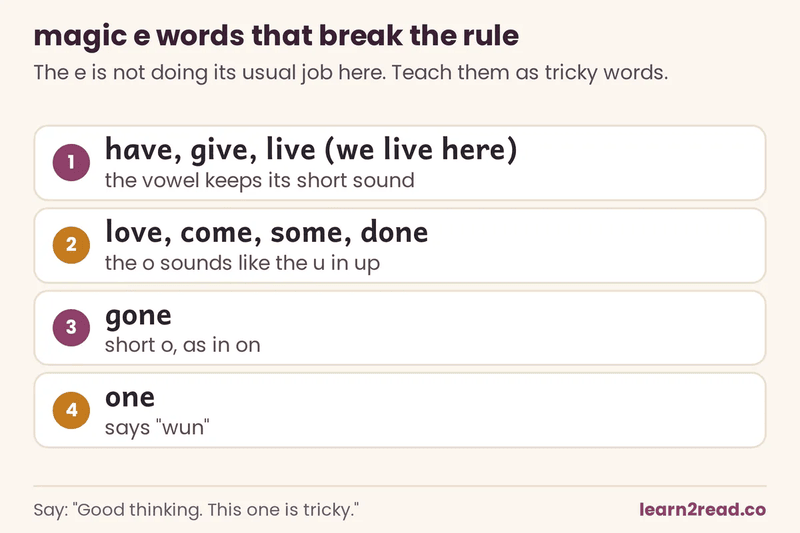
Magic e words that break the rule are common words ending in a consonant and e where the vowel keeps a short or different sound. They include "have", "give", "live", "love", "come", "some", "done", "gone" and "one". ("live" has two readings: "we live here" breaks the rule, while "a live fish" follows it.) Teach these as tricky words (words with a part that doesn't follow the usual rule) once magic e is secure, and tell your child honestly that the e isn't doing its usual job here.
The UK's Letters and Sounds guidance flags three of them directly: "Although ending in the letter e, some, come and have are not split digraph words." Reading Universe gives "have" and "give" as examples where "the 'e' does not make the previous vowel say its name."
Why do they exist? The short answer is history. English spelling kept an e on many words for reasons that have nothing to do with vowel sounds, and words like "give and love" are among them.
A child who reads "have" as "hayv" isn't being careless. They're applying the rule you taught, which is a good sign.
Say: "Good thinking, that's how magic e usually works. This one is tricky, and it says have." Our sight words guide shows how to teach tricky words by sounding out the regular part.
Word | What a child might say | What it says | Why |
have | hayv | have (short a) | tricky word |
give | gyve | give (short i) | tricky word |
come | kohm | come ("u" sound) | tricky word |
some | sohm | some ("u" sound) | tricky word |
one | ohn | "wun" | tricky word |
4 Magic e Games to Play at Home
The four best magic e games for home are the magic wand, real or silly, read and draw, and sort the pile. Each takes five minutes and needs only paper, a pen and a few cards.
The magic wand. Make a paper "wand" with a lowercase e on the end. Write "cap, kit, hop, cub, pin, tap" on cards. Your child reads the word, taps the wand on the end, and reads the new word. Children love being the one who does the magic.
Real or silly? Mix real and made-up words: "cap" to "cape" (real), "bed" to "bede" (silly), "pin" to "pine" (real), "fun" to "fune" (silly). Your child reads each one and calls out "real!" or "silly!". This checks they're reading the letters, since they can't guess.
Read and draw. Write a pair, like "kit" and "kite". Your child reads both and draws a quick picture of each. Pairs that work well: cub and cube, pin and pine, cap and cape, cut and cute. Drawing proves they know which word is which.
Sort the pile. Mix ten cards, half with magic e and half without. Your child reads each card and puts it on the "short" pile or the "long" pile. Speed it up over the week.
Common Magic e Mistakes and What to Say
Most magic e mistakes come from one of two places: the child forgets to look at the end of the word before reading, or they start adding the long sound to every word. Both are normal for a few weeks.
What your child does | What's going on | What to say |
Reads "cape" as "cap" | Didn't look at the end of the word first | "Check the end. Is there an e?" |
Reads "cape" as "cap-ee" | Sounds out the e as if it were a sound | "This e is silent. What does it do to the a?" |
Reads "hop" as "hope" | Over-using the new rule | "Is there an e on the end? No e, so the o says its sound." |
Reads "have" as "hayv" | Applying the rule to a tricky word | "Good thinking. This one is tricky. It says have." |
Spells "kite" as "kit" | Can hear the long sound but forgets the e when writing | "Say it slowly. Do you hear the i saying its name? Then it needs an e." |
The last row matters more than parents expect. Reading magic e words usually comes before spelling them, because when your child writes, they have to choose the e themselves.
And the "ay" sound can also be spelt "ai" (rain) or "ay" (play), so spelling takes longer. Our guide for a child who can read but can't spell covers that gap.
Is all this worth the effort at home? The Education Endowment Foundation, which reviews teaching research in the UK, rates the evidence for phonics as high and estimates that phonics adds an average of +5 months of progress. Magic e is one small, clear step in that phonics sequence, and 10 minutes a day is enough for most children.
FAQs
How do you teach magic e to a child?
Tell your child that the e at the end of the word is silent, and that its job is to make the vowel before it say its name. Show them "cap", then add an e to make "cape", and let them hear the a change from its short sound to its name. Pairs of words make the idea clear faster than any explanation.
At what age do children learn magic e (UKG, KG2 or class 1)?
Most children learn magic e at around 5 to 6, in class 1 in India, Year 1 in the UK and first grade in the US. A child is ready once they can read short words like cat, pin and hop smoothly and know the short sound of each vowel. Some UKG books introduce it earlier, which is fine for a child who already blends easily.
What are some magic e words for class 1?
Good magic e words for class 1 are short pairs where the child already knows the word without the e: cap and cape, kit and kite, hop and hope, cub and cube, tap and tape, pin and pine, not and note. After pairs, move to common words like cake, game, bike, five, home, bone and cute.
Is magic e the same as silent e and split digraph?
Mostly. Magic e and split digraph name the same pattern, where a vowel, one consonant and a final e make the vowel say its long sound; split digraph is the UK school term. Silent e is a wider term, because in words like have and give the e is silent but doesn't change the vowel.
Why do words like have, give and come end in e?
These words end in e for historical spelling reasons, and the e doesn't make the vowel say its name. They're best taught as tricky words once a child is confident with the usual magic e rule. Reading Universe and the UK government's Letters and Sounds guidance both list have as an exception to the pattern.
My child reads every word with a long vowel now. Is that normal?
Yes. After learning magic e, many children over-use it for a few weeks and read "hop" as "hope". Ask them to check the end of the word before reading, and mix words with and without an e so they have to look every time.
What sound does magic e make?
None. The e is silent, and its only job is to make the vowel before it say its name, so cap becomes cape and kit becomes kite.
Should I teach magic e for reading or spelling first?
Teach magic e for reading first. Children usually read magic e words well before they spell them, because spelling asks them to remember to add the e and to choose between spellings like a-e, ai and ay. Start spelling practice once reading the pairs feels easy.
Read Next
How to Teach Blending: When Your Child Knows the Sounds but Can't Read the Word: if three-letter words still don't come smoothly, start here before magic e.
Decodable Books: A Parent's Complete Guide (Ages 4-7): how to find books that practise magic e words.
Why Your Child Can Read But Can't Spell, and How to Fix It: for when "kite" keeps getting written as "kit".
Here is how to teach magic e in one line: start from a word your child already reads, add the e, and let them hear the vowel say its name. Ten minutes a day, one vowel at a time, and most children have it within a few weeks. If you'd like a teacher to take your child through magic e and the rest of class 1 phonics, book a free trial class with Learn2Read, a live online phonics programme for children aged 3 to 12.

Latest Posts
14 November 2026
How Many Words Per Minute Should a 6 Year Old Read? (2026)
11 November 2026
When Do Kids Stop Sounding Out Words? UKG to Class 2 Guide

7 November 2026
Child Refuses to Read at Home? Check the Book First, Age 4-8

A new chapter from Learn2Read
Read Before They Read
Before you teach your child to read, read this. A calmer, clearer way into your child’s reading journey—with a practical guide written for real Indian homes.