7 October 2026
Reading Aloud to Kids: How Long, How Often, When to Stop
Reading Aloud to Kids: How Long, How Often, When to Stop
posted on : 12 September 2026
Some nights you read three books. Some nights you skip it, because it is 8:40pm and everyone has had enough.
And then a quieter question arrives, usually around age six or seven: she can read by herself now — do I still need to do this?
Reading aloud to your child is the single highest-return ten minutes in a parent's day, and the research puts a number on it that is genuinely startling. Below: exactly how many words are at stake, how long to read at each age, whether to stop once your child reads independently (no), and what to do when your child will not sit still for any of it.
How Many Words Does Reading Aloud Actually Add?
A child read five books a day hears roughly 1.4 million more words by age five than a child who is never read to at home. That figure comes from a 2019 Ohio State University study by Jessica Logan, published in the Journal of Developmental and Behavioral Pediatrics.
What makes the study useful for parents is not the headline — it is the ladder underneath it. Logan's team counted the words in 30 books drawn from the most-borrowed board books and picture books at a public library, then estimated what a child hears by age five at different reading frequencies.
How often a child is read to | Words heard from books by age 5 |
never | 4,662 |
1-2 times a week | 63,570 |
3-5 times a week | 169,520 |
every day (one book) | 296,660 |
five books a day | 1,483,300 |
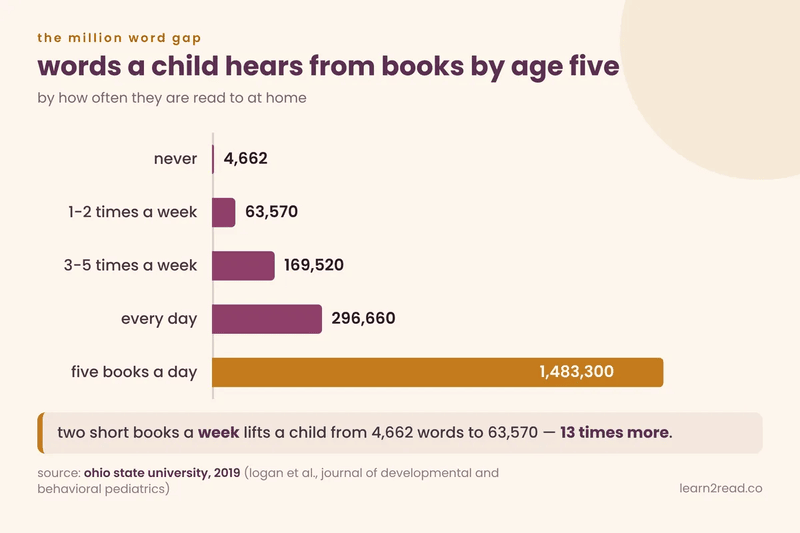
Look at the jump between never and 1-2 times a week. That is a 13-fold increase for two short books a week. You do not need to be a five-books-a-day household to move your child a very long way up this ladder — and if the guilt of the skipped night is what has been sitting on your chest, that row is your permission slip.
Logan's own explanation of why it matters: "Kids who hear more vocabulary words are going to be better prepared to see those words in print when they enter school. They are likely to pick up reading skills more quickly and easily."
This is also the quiet reason books beat conversation for vocabulary. Everyday talk with a young child runs on a few hundred repeated words — shoes, dinner, careful, tired. Books contain shimmering, reluctant, voyage, beneath. Your child will not meet those words at the dinner table.
How Long Should You Read Aloud Each Day?
Ten to twenty minutes a day, most days, is the target that works for almost every family — and consistency beats duration every time.
Stage | Aim for | What it looks like |
ages 0-2 | 5-10 min, several short bursts | board books, naming pictures, letting them chew the corner |
ages 3-4 | 10-15 min | picture books, same favourite on repeat, joining in on the rhymes |
ages 5-6 | 15-20 min | longer picture books, early chapter books, first "what happens next" |
ages 6-8 | 15-20 min | chapter books above their own reading level, one chapter a night |
Two things about that table. First, "most days" is the honest standard — nobody reads every single night, and a missed night costs nothing. Second, the minutes are cumulative: three five-minute books across a Saturday is the same fifteen minutes.
If bedtime is the war zone in your house, move it. Read after breakfast, in the car park before pickup, in the bath. The evidence is about the reading, not the hour.
Should You Stop Once Your Child Can Read Alone?
No — and this is the moment most families quietly stop, right when read-alouds start doing their most valuable work.
Here is why. A six-year-old's own reading is limited by the words they can decode. Their listening runs years ahead of that. So the book you read aloud can be harder, stranger and richer than anything they could read themselves — which means the read-aloud is where the ambitious vocabulary, the long sentences and the complicated stories come from. Hand that job to their own reading and it disappears for years.
There is also the part no study measures. Being read to is one of the few times a young child gets an adult's undivided attention with nothing being asked of them. Children who are reading fluently at seven still want it, and they will not always say so.
So: keep reading aloud and let them read to you. Both, not one instead of the other. A good split at ages six to eight is your child reading a short decodable or early reader to you, then you reading a chapter of something much bigger to them.
What to Read (and What Counts)
Almost everything counts. The list below rules a lot fewer things out than parents expect.
Counts: picture books · chapter books read aloud · non-fiction about dinosaurs, trucks or space · comics and graphic novels · recipe steps · the same book for the fortieth time · books in your home language rather than English.
Also counts, more than you would think: re-reading. A child who asks for the same book nightly is not stuck. Repetition is how words move from "heard once" to "known" — the fourth reading is often where the vocabulary actually lands.
Doesn't quite count: an audiobook playing while your child does something else, and a screen reading the book for them. Both have value, and neither gives you the thing that makes read-alouds work — the pausing, the pointing, the "wait, why did he do that?"
One reassuring data point on where reading for pleasure stands: the National Literacy Trust's 2026 survey of 125,375 children in the UK found daily reading among 5-8 year olds at 45.5%, and reading enjoyment rising for the first time since 2021. The decline is not inevitable — and the youngest readers are where it turns around.
How to Read Aloud So It Actually Works
Talk about the book while you read it. That single habit does more than any other technique, and it takes no preparation.
Ask before you turn the page. "What do you think she'll do?" Two questions per book is plenty. More than that turns a story into a test.
Point at the words sometimes — not always. For children under six, running your finger under the text occasionally shows them that print goes left to right and that those marks are the words you are saying. Do it for a line or two, then stop and just read.
Let them choose, even badly. The book you find unbearable is doing the same job as the one you love. Choice is most of what keeps a child coming back.
Explain one word, not five. When you hit reluctant, give it half a sentence — "reluctant means he really didn't want to" — and carry on. Stopping to define everything kills the story, and the story is what carries the words into memory.
Stop before they want you to. Ending on "one more chapter tomorrow" is how tomorrow's session gets easier. Reading until your child is squirming teaches them that books end in boredom.
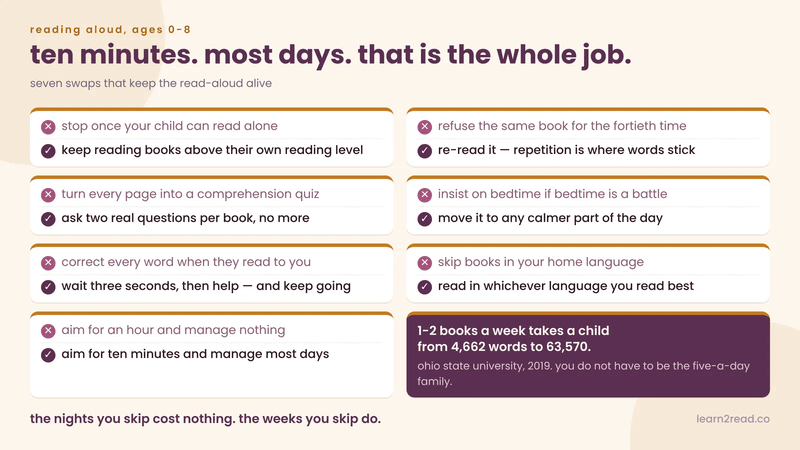
7 Do's and Don'ts of Reading Aloud
❌ Don't | ✅ Do instead |
stop once your child can read alone | keep reading books above their own reading level |
refuse the same book for the fortieth time | re-read it — repetition is where words stick |
turn every page into a comprehension quiz | ask two real questions per book, no more |
insist on bedtime if bedtime is a battle | move the read-aloud to any calmer part of the day |
correct every word when they read to you | wait three seconds, then help — and keep going |
skip books in your home language | read in whichever language you read best |
aim for an hour and manage nothing | aim for ten minutes and manage most days |
What If My Child Won't Sit Still?
Let them move. Sitting still is not the skill you are building, and a child who is listening while lying upside down off the sofa is still hearing every word.
Things that reliably help:
Let them hold something. Lego, a fidget, a soft toy. Hands busy, ears free.
Read while they do something else quiet — in the bath, during a snack, while they draw.
Choose shorter books, not fewer. Three two-minute books beat one ten-minute book that gets abandoned.
Let them "read" too. A toddler who wants to turn the pages, name the pictures and skip four pages at once is participating, not disrupting.
Try non-fiction. A child who cannot sit through a story will often sit through a book about sharks. It counts.
If your child seems to actively avoid books rather than just wriggle — pushing them away, changing the subject, getting upset — that sometimes means the reading itself has started to feel like failing. Our guide to making your child love reading covers how that happens and how to undo it.
Frequently Asked Questions
How long should I read aloud to my child each day?
Ten to twenty minutes a day, most days, depending on age: about 5-10 minutes for children under three, 10-15 minutes at ages three to four, and 15-20 minutes from five onwards. The minutes can be split across the day, and consistency matters more than length.
Should I keep reading aloud after my child can read independently?
Yes. A young child's listening comprehension runs well ahead of the words they can decode themselves, so read-alouds are where richer vocabulary and more complex stories come from. A good approach at ages six to eight is to have your child read a short book to you, then read a more challenging chapter book to them.
How many words does reading aloud add to my child's vocabulary?
A 2019 Ohio State University study estimated that a child read five books a day hears about 1.4 million more words from books by age five than a child never read to. Even one to two books a week produced roughly 63,570 words heard by age five, compared with about 4,662 for a child never read to.
Do audiobooks count as reading aloud?
Partly. Audiobooks build vocabulary and a love of story, so they are worth having. They do not replace a read-aloud, because they cannot pause when your child looks confused, point at a picture, or answer "why did he do that?" — the back-and-forth is what makes a read-aloud work.
Is it okay to read the same book over and over?
Yes, and it is actively useful. Repeated readings are how a new word moves from vaguely familiar to properly known, and children usually pick up different details each time. A child requesting the same book for weeks is doing exactly what they should.
Should I read in English or in our home language?
Read in whichever language you read most fluently and expressively. The vocabulary, story structure and listening skills a child builds transfer across languages, and a warm, confident read-aloud in a home language is worth far more than a hesitant one in English.
My child won't sit still for a story. What should I do?
Let them move and give their hands something to do. Children absorb a read-aloud while building, drawing, fidgeting or lying upside down. Shorter books, non-fiction about a topic they love, and reading during a bath or snack all work better than insisting on stillness.
Read Next
Sight Words for Kids: How Many, Which Ones, and How to Teach Them — the next step once your child starts wanting to read the words themselves.
Reading Milestones by Age: What Your Child Should Do at 3, 4, 5, 6 and 7 — where your child is now, and what typically comes next.
How to Make Your Child Love Reading (and Why So Many Kids Quit by Age 8) — protecting the habit through the years it usually drops off.
__________________________________________________
Reading aloud builds the vocabulary. Phonics gives your child the tools to get those words off the page themselves. Learn2Read, a live online phonics program for children aged 3-12, teaches the sounds in a structured order with trained teachers — so the bedtime story stays the fun part.

Latest Posts
3 October 2026
Early Signs of Dyslexia in Children: Ages 4 to 7, and 5 Things That Look Like It
30 September 2026
My Child Can Read But Doesn't Understand: Why It Happens and How to Fix It (Ages 5 to 8)
26 September 2026