7 October 2026
Sight Words for Kids: How Many & How to Teach Them
Sight Words for Kids: How Many & How to Teach Them
posted on : 9 September 2026
Your child can sound out cat, mop and bin without blinking. Then they hit the word said — and everything stops.
You buy the flashcards. You do ten minutes a night. By Friday your child can rattle off twenty cards in order. On Saturday, in an actual book, they look at said like they have never met it before.
You are not doing it wrong. You have been given the wrong instructions.
Sight words for kids are not a memory game, and the flashcard-drill method most of us were handed is the slowest possible route. This guide gives you the honest answer to the three questions parents actually ask — how many sight words your child needs, which ones to teach first, and how to teach them so they stick in a book and not just on a card. It takes about five minutes a day.
What Are Sight Words, Really?
A sight word is any word your child reads instantly, without stopping to sound it out. It is not a special category of word — it is a finish line every word eventually crosses.
That one sentence undoes most of the confusion. Parents are told "sight words are words you memorise because they don't follow the rules." That is not what reading researchers mean. Reading Rockets defines sight words simply as "words that you read instantly," and explains that getting there means "forming permanent connections between a word's letters, its pronunciation, and its meaning in memory."
Here is the part that changes how you teach at home: cat is a sight word too. Your child sounded it out perhaps eight times, and then stopped needing to. The goal is not to build a small pile of memorised words. The goal is to get every word into instant recall — and sounding out is the machinery that does it.
Reading scientist Timothy Shanahan puts it plainly: "If decoding is taught well and effectively students eventually recognize almost all words as sight words."
Sight Words vs High-Frequency Words vs Tricky Words
These three phrases get used as if they mean the same thing. They don't, and knowing the difference tells you exactly what to do with each word.
Term | What it actually means | Example | What you do at home |
sight word | any word your child reads instantly, with no sounding out | cat, mum, the, said | nothing special — this is the result |
high-frequency word | a word that shows up constantly in print, whether or not it is regular | and, it, was, you | teach early, because your child meets it everywhere |
tricky word (also called irregular word) | a word where one part does not follow the usual sound pattern | said, one, come, of | sound out the regular parts, flag the odd part |
decodable word | a word your child can read using sounds they already know | pot, ship, stand | practise in books, not on cards |
Most high-frequency words are perfectly regular. and, in, it, can, on, not, stop, him, get — your child can sound out every one of those. They do not need memorising at all.
The genuinely tricky ones are a much smaller group than parents fear. Reading Rockets notes that about 100 words account for roughly 50% of the words used in school and college texts — and only about 25% of those 100 are irregular. So out of the words your child meets most often, roughly 25 need the special treatment. Not 220. Not 1,000.
That is the whole flashcard industry, right-sized.
How Many Sight Words Should My Child Know by Age?
Far fewer than the lists suggest. Shanahan recommends roughly 20 words by the end of the kindergarten year, with at least 10 of them high-frequency words — and calls a target of 60 "high."
This is the number no worksheet packet will tell you, so here it is next to the ages parents recognise.
Stage (ages vary by country) | Roughly | What "knowing it" should look like |
ages 3-4 — nursery / pre-school | 0 words | none needed yet; the work is hearing sounds in words |
ages 4-5 — pre-K / reception | a handful (2-5) | recognises their own name and one or two words like the, is |
ages 5-6 — kindergarten / reception-year 1 | about 20 (10+ high-frequency) | reads them in a book, not just on a card |
ages 6-7 — grade 1 / year 2 | the 100 most frequent words | plus 300-500 easy-to-decode words, usually by mid-year |
ages 7-8 — grade 2 / year 3 | instant recall of most common words | reading fluency, not word lists, is now the focus |
Shanahan warns that pushing 100 words by October of first grade is "ambitious" and likely to produce widespread failure. If your child's school list feels relentless, your instinct is probably right.
School calendars differ — India's year starts around April, the US, UK and Gulf around August or September — so use the ages, not the grade names.
One caution worth more than any list: a child who is behind on sounds cannot be rescued with more sight words. If your five-year-old cannot yet hear that sun starts with /s/, sight-word cards will not fix that. Our reading milestones by age guide shows what typically comes first.
Which Sight Words Should You Teach First?
Start with the words that do the most work in the sentences your child is actually reading. These are the first 20 to know, written the way your child will see them — all lowercase, because that is how books are printed.
the · a · is · it · in · and · to · was · you · said · of · he · she · we · my · me · like · go · see · come
Note what is happening in that list. Most of these are regular: it, in, and, he, we, my, me, go, see can all be sounded out. Only the, was, said, of, come and you need the tricky-word treatment.
You will also meet two famous lists: the Dolch list (220 service words plus 95 common nouns, built in the 1930s and 40s) and the Fry list (1,000 words in sets of 100, built in the 1950s and updated later). Both are fine as inventories of what turns up often in print. Neither is a teaching sequence, and neither was designed to be worked through card by card. Use whichever list your child's school uses — but teach the words the way the next section describes, not by drilling.
How to Teach Sight Words at Home (5 Minutes a Day)
Teach the sounds inside the word first, then flag only the part that misbehaves. This is called orthographic mapping — Reading Rockets describes it as "the process of storing a word permanently in memory for instant retrieval," using "what we know about letter-sound relationships plus our awareness of speech sounds to map letter patterns and words together as units."
In plain terms: your child's brain files a word by its sounds, not by its shape. So give it sounds.
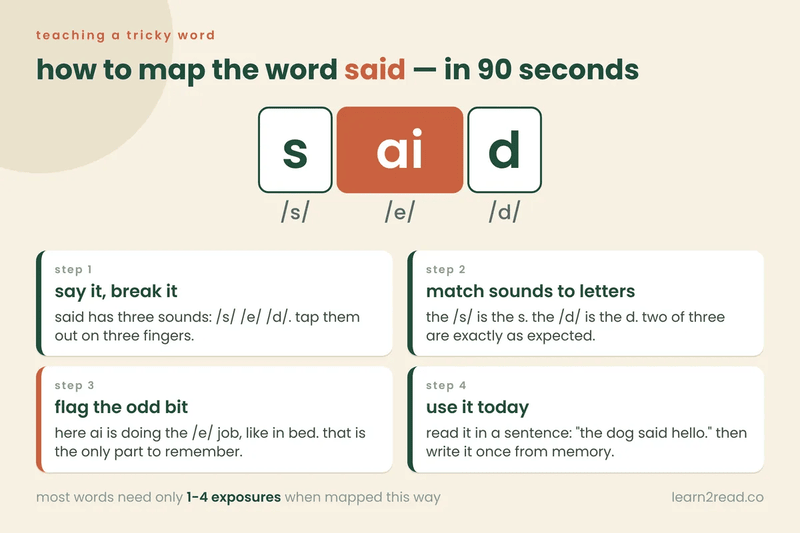
Here is the routine, using said as the example. It takes about 90 seconds per word.
1. Say it, then break it. Say the word. Ask your child how many sounds they hear. said has three: /s/ /e/ /d/. Tap them out on three fingers.
2. Match sounds to letters. Write the word. Point at each part: "the /s/ is the s. The /d/ is the d." Two of the three are exactly what your child expects.
3. Flag the odd bit. Circle or underline ai. "This is our tricky part. Here, ai is doing the /e/ job — like in bed. That's the bit we remember." Naming one small part as odd is far easier than memorising a whole word.
4. Use it immediately. Read a sentence that contains it. "the dog said hello." Then have your child write the word once from memory and check it. Done.
Do two or three words like this, three or four times a week. That is five minutes.
Two more things that quietly do the heavy lifting:
Read the word in books, not just on cards. A word met in a sentence gets meaning attached to it, and meaning is one of the three threads that pin a word in memory. Decodable books are built exactly for this.
Expect it to be fast. Reitsma's 1983 research, cited by Reading Rockets, found skilled readers need as few as one to four exposures to fix an irregular word in memory when the word is mapped this way. If a word is taking twenty rounds, the method is the problem, not your child.
The Flashcard Trap: Why Drilling Backfires
Flashcards fail for a specific, fixable reason: they train your child to recognise a picture of a word rather than store its sounds. A picture works on a card, in a familiar order, in your handwriting. It falls apart in a book.
Most of us have done this. It is the default advice everywhere. Here is what to do instead.
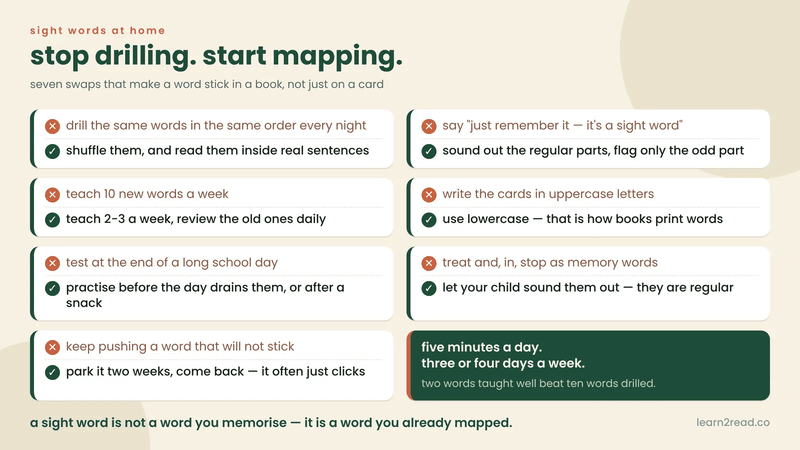
❌ Don't | ✅ Do instead |
drill words in the same order every night | shuffle, and read them inside real sentences |
say "just remember it — it's a sight word" | sound out the regular parts, flag only the odd part |
teach 10 new words a week | teach 2-3 a week and review the old ones daily |
use uppercase letters on cards | use lowercase — that is how books print words |
test at the end of a long school day | practise before the day drains them, or after a snack |
treat and, in, stop as memory words | let your child sound them out — they are regular |
keep pushing a word that will not stick | park it for two weeks, come back, it often just clicks |
What If My Child Forgets Words They Knew Yesterday?
Forgetting is not failure — it is the normal middle of the process, and it usually means the word was memorised rather than mapped.
Check three things before worrying:
Did the word go in by sound or by shape? If your child learned come purely as a picture, it will vanish and reappear at random. Re-teach it with the four steps above.
Is the word appearing anywhere except practice? A word your child only meets during "sight word time" has nothing holding it in place. Find it in a book tonight.
Is your child tired? Word recall is the first thing to go at the end of a school day. That is the same energy crash behind after-school meltdowns — the tank is empty, not the memory.
If a child aged six or older is still struggling to hold on to common words after several months of consistent, sound-based practice — or cannot reliably hear individual sounds in short words — it is worth raising with their teacher and, if it continues, their doctor. Persistent difficulty with sounds is one of the earliest signals worth a proper look, and looking early is always the kinder choice.
Frequently Asked Questions
How many sight words should a 5-year-old know?
About 20 by the end of the kindergarten year, with at least 10 of those being high-frequency words, according to reading researcher Timothy Shanahan. A target of 60 words is considered high for that age. Quality matters more than quantity: a child who reads 20 words instantly inside a book is further along than a child who recites 60 from cards.
Should I teach phonics or sight words first?
Phonics first, and phonics alongside. Sounding out is the mechanism that turns any word into a sight word, so a child with strong letter-sound knowledge converts new words to instant recall far faster. Teach a small number of very common words early — including a few irregular ones like the and said — while phonics does the main work.
Are sight words the same as high-frequency words?
No. A high-frequency word is one that appears often in print, such as and or was. A sight word is any word a child reads instantly, whether or not it is common. Most high-frequency words are perfectly regular and can be sounded out rather than memorised.
Do I need the Dolch or Fry list?
Not necessarily. Both are inventories of words that appear often in print, not teaching sequences. Use whichever list your child's school uses so you are reinforcing the same words, and teach each word by mapping its sounds rather than working down the list card by card.
How long should sight word practice take each day?
About five minutes, three to four times a week. Two or three words taught properly beats ten words drilled. Short, frequent practice is how young children retain best — long sessions produce resistance without producing recall.
My child reads the word on the card but not in the book. Why?
Because the word was stored as a shape rather than as a sequence of sounds, and the shape only works in the setting where it was learned. Re-teach the word by breaking it into sounds, matching each sound to its letters, and then reading it inside a sentence the same day.
When should I stop teaching sight words?
Once your child is reading connected text with reasonable fluency — usually around ages seven to eight — separate sight-word practice has done its job. From then on, words become instant through reading itself, which is why volume of reading matters more than word lists at that stage.
Read Next
Phonics vs Sight Words: Which Should You Teach First (and Why It Matters) — the full comparison, if you want the reasoning behind the order.
Decodable Books: What They Are, Why They Work, and How to Choose One — the books that let your child practise new words in real sentences.
Phonics Sound Chart for Kids: All 44 Sounds with Examples — the sounds your child is mapping words onto, in one printable place.
__________________________________________________
Five minutes, three days a week, done the right way, will take your child further than a stack of cards ever did. If you would like a trained teacher to do this alongside you, Learn2Read runs live online phonics classes for children aged 3-12 — small groups, real teachers, and a structured order of sounds so nothing gets skipped.

Latest Posts
3 October 2026
Early Signs of Dyslexia in Children: Ages 4 to 7, and 5 Things That Look Like It
30 September 2026
My Child Can Read But Doesn't Understand: Why It Happens and How to Fix It (Ages 5 to 8)
26 September 2026