
7 October 2026
Why Your Child Guesses at Words (and How to Stop It)
Why Your Child Guesses at Words (and How to Stop It)
posted on : 16 September 2026
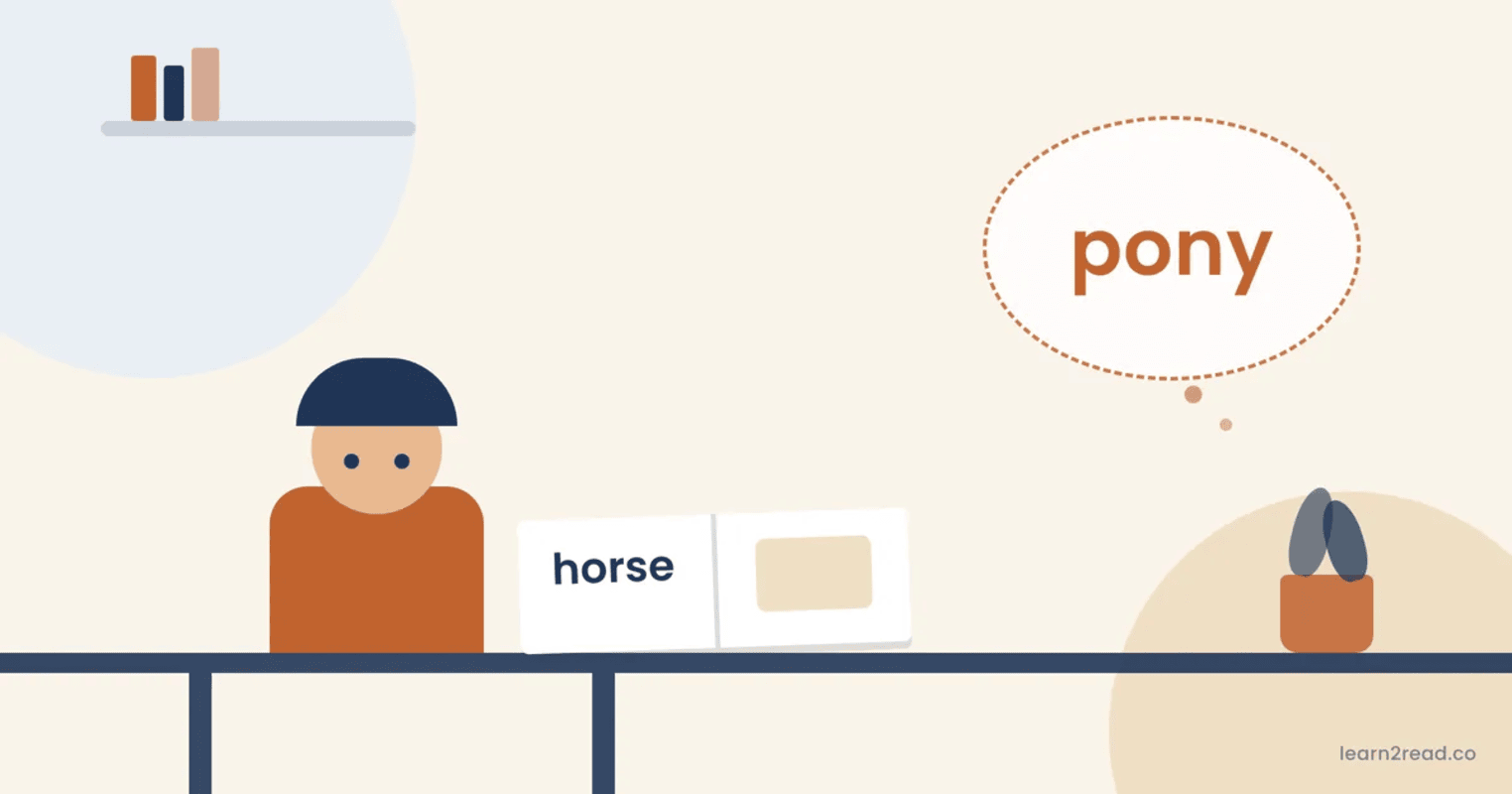
Your child looks at the page. Looks at the picture. Says "pony." The word was "horse."
If your child guesses at words while reading, it almost always means they've been taught to use the picture and the sentence to work out a word, instead of the letters in it. That's a teaching habit, not a reading problem, and it's fixable at home in a few weeks. This guide shows you how to tell guessing apart from reading, what to say in the moment it happens, and the four-week routine that replaces the habit with actual decoding.
Here's the thing worth knowing up front: a child who guesses is usually a clever child. Guessing takes intelligence. It's just aimed at the wrong target.
Why Does My Child Guess at Words?
Children guess at words because guessing works, right up until it doesn't.
In a picture book for five-year-olds, the pictures carry the story and the sentences repeat. "I see the ___" with a drawing of a dog. A bright child needs about a week to notice they can read the whole book without looking closely at a single word. They get praise. They finish the book. Nothing about that morning tells them anything is wrong.
Then the books change. Around ages six and seven, pictures shrink and sentences stop repeating. Suddenly horse and house and pony all sit in text that gives no clue which is which. The strategy that worked all year collapses, usually within a term, and to a parent it looks like the child has gone backwards.
They haven't. The scaffolding was always temporary.
There's a second reason, and it's the uncomfortable one: many children were taught to guess on purpose. For decades, reading instruction has included a method where children are encouraged to work out an unknown word using three "cues" (meaning, sentence structure, and the letters). Education Week, reporting on schools moving away from it, describes the core problem plainly: encouraging kids to check the picture when they hit a tricky word "can take their focus away from the word itself." Nell Duke, a literacy professor at the University of Michigan, told the same publication that the approach "has led to a lot of misconceptions."
If your child's teacher has ever suggested "look at the picture, what would make sense there?", this is where the habit came from. Nobody was being careless. It was standard advice.
The Three Cues, and Why Two of Them Hurt
Reading a word has exactly one reliable route: the letters. Meaning and sentence structure are useful for checking, and useless for identifying.
| The cue | What the child is told | What it actually does |
| meaning (the picture, the story) | "what would make sense here?" | produces a word that fits the story and isn't the word on the page |
| structure (the sentence) | "what sounds right?" | narrows it to the right sort of word, never to the word |
| letters and sounds | "sound it out" | identifies the word, every time, in every book |
The reason this matters more than it sounds: research on adult reading shows the sentence itself usually isn't predictive enough to name a word. Luke and Christianson, publishing in Cognitive Psychology in 2016, found that most naturally occurring text is "only weakly or moderately constraining." Skilled adult readers, with a full vocabulary and years of practice, still can't reliably guess what's coming next. A six-year-old certainly can't.
So when we ask a child what would make sense, we're asking them to do something that doesn't work, using a skill that isn't the one they need to build.
Proficient readers, as Education Week puts it, "don't need to rely on context or syntax to identify what words say." They look and they know, because the word is stored. Reading Rockets calls that storage orthographic mapping, "the process of storing a word permanently in memory for instant retrieval." It's built out of sounds. Guessing never feeds it, which is why a guessed word never sticks. Your child can guess horse correctly on Monday and miss it on Thursday, because nothing was filed.
How to Tell Guessing From Reading
Cover the picture. That's the whole test, and it takes two minutes.
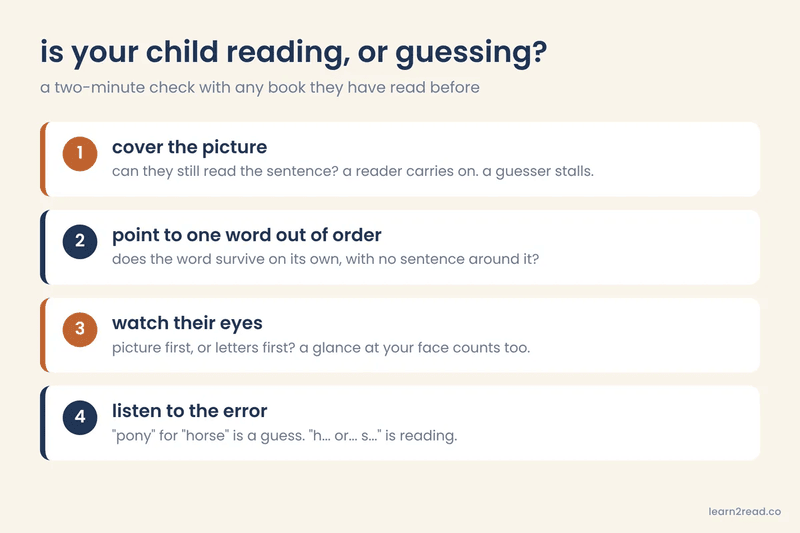
Sit with a book your child has read before and try this:
Cover the picture with your hand and ask them to read the sentence. A reader carries on. A guesser stalls, or produces a word that isn't there.
Point to one word out of order. Pick a word from the middle of the page and ask what it says on its own. Guessing needs the sentence around it. Reading doesn't.
Watch what their eyes do. A glance at the picture before the word is the tell. So is a glance at your face.
Listen for the shape of the error. This is the most useful signal of all, and the table below breaks it down.
What your child says for "horse" | What it tells you |
"pony" | guessing from meaning. The picture is doing the reading. |
"house" | reading the first letter then guessing the rest. Half a strategy. |
"h... or... s..." then "horse" | decoding. Slow is fine. Slow is correct. |
"hor-se" then stops, puzzled | decoding fine, doesn't know the word. That's vocabulary, not reading. |
That last row catches parents out. A child who sounds a word out perfectly and still looks blank has read it. They just haven't met it before. Tell them what it means and move on, because that's a different job entirely.
What to Say in the Moment
Say nothing about the meaning. Send them back to the letters. Screenshot this for tonight.
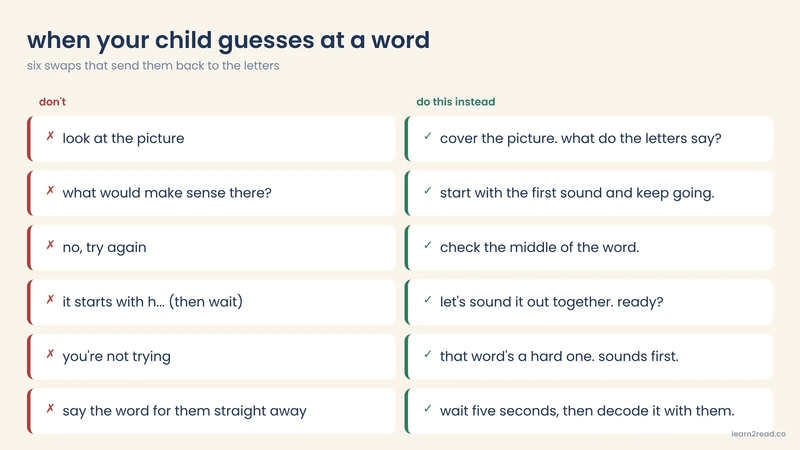
❌ Don't say | ✅ Say instead |
"look at the picture" | "cover the picture. what do the letters say?" |
"what would make sense there?" | "start with the first sound and keep going." |
"no, try again" | "check the middle of the word." |
"it starts with h" (then wait) | "let's sound it out together. ready?" |
"you're not trying" | "that word's a hard one. sounds first." |
nothing, and you supply the word | wait five seconds, then decode it with them |
Two of those deserve a note.
Supplying the word is the one almost every parent does, and it's the most understandable. Bedtime is long, the child is tired, and reading the word for them keeps the story moving. Do it occasionally and nothing happens. Do it every time and your child learns that stuck means wait, so waiting becomes the strategy. Five seconds of silence feels much longer than it is. Count it.
And "you're not trying" lands badly for a specific reason: a guessing child is usually trying very hard, at the wrong thing. They'll hear the criticism and not know what to change.
The Four-Week Habit Swap
Guessing is a habit with a reward attached, so the fix is to make decoding the thing that gets rewarded. Ten minutes a day, four times a week.
Week 1: change the book. Put the picture-heavy readers aside for a month and read books your child can actually decode. Decodable books exist for exactly this: the words are built from sounds your child already knows, so there's nothing to guess and no picture worth checking. This single swap does more than everything else combined, because it removes the reward.
Week 2: add the cover-up. Read as normal, with your hand over the illustration on each page. Uncover it afterwards and talk about it. The picture becomes the treat at the end rather than the tool.
Week 3: go word-hunting. Two minutes, out of order. Open any page and ask for single words, pointing at random. No sentences, no pictures, no context to lean on. Your child will be slower than you expect on words they "knew" last week. That's the habit becoming visible.
Week 4: rebuild the tricky words properly. Whatever words keep failing, teach them by sound. The routine is in our sight words guide: break the word into sounds, match sounds to letters, flag the one odd part, use it in a sentence the same day. Reading Rockets, citing Reitsma's 1983 research, notes that skilled readers can fix an irregular word in memory in as few as one to four exposures when it's mapped this way. Flashcard drilling takes twenty rounds and doesn't hold, which is the difference between filing a word and photographing it.
Expect week three to feel like going backwards. It isn't. Accuracy drops when a child stops guessing and starts decoding, then climbs past where it was. Speed comes last.
Will My Child Ever Use Context?
Yes, constantly, for meaning. Never for identification.
This is the distinction that gets lost in the argument about all this. A strong reader uses context to work out which meaning a word carries: whether the bat flew away or got hit, whether the bank is money or river. That's comprehension, and it's the point of reading. What they don't do is use context to decide what the letters say.
So you're not teaching your child to ignore the story. You're teaching them to identify the word first and think about it second, in that order, because the other order produces a reader who is fluent in easy books and stuck in real ones.
Timothy Shanahan, a former president of the International Literacy Association, puts the destination well: "If decoding is taught well and effectively students eventually recognize almost all words as sight words." Instant recognition is where every reader ends up. Sounding out is the road, and guessing is a different road that doesn't arrive.
When Guessing Means Something Else
Most guessing is a taught habit and clears up with the routine above. Talk to your child's teacher, and then your doctor, if after several weeks of consistent, sound-based practice you're still seeing:
guessing that stays random, with the first letter ignored entirely
real difficulty hearing separate sounds in short spoken words, with no picture involved
words read correctly on one line and missed two lines later, over and over
physical resistance to reading: headaches, stomach aches, tears at the sight of a book
a child aged seven or over who can't reliably decode simple three-sound words like pot or ship
None of these means something is wrong for certain. They mean it's worth a proper look rather than another month of practice at home, and looking early is always kinder than waiting. Our reading milestones by age guide sets out what's typical at each stage.
Frequently Asked Questions
Why does my child guess at words instead of reading them?
Because guessing has been working. In picture books with repeating sentences, a child can get every word right by reading the illustration and the pattern instead of the letters, and they're praised for it. The strategy fails around ages six to seven when pictures shrink and sentences stop repeating. Many children were also explicitly taught to guess, through a method that tells them to ask what word would make sense in the sentence.
Should I tell my child to look at the picture when they get stuck?
No. Send them to the letters instead: "cover the picture, what do the letters say?" Checking the picture moves a child's attention away from the word, and a word identified from a picture isn't stored in memory, so the same word will fail again next week. Look at the picture afterwards, to talk about the story.
Is it bad to sound out words? Isn't that slow reading?
Sounding out is slow on purpose and it's the correct stage. Each time a child decodes a word, they build the letter-to-sound connections that let them recognise it instantly later. Speed arrives as a result of decoding, not as an alternative to it. A child reading slowly and accurately is further ahead than one reading quickly and guessing.
My child reads fluently at school but guesses at home. Why?
Usually because the school books are familiar and the home books aren't. Fluency on a book that's been read five times can be memory rather than reading. Test it by covering the picture and asking for single words out of order in a book your child hasn't seen.
How long does it take to stop the guessing habit?
Around four weeks of short, daily practice for most children, with accuracy dipping in the middle before it improves. The single biggest lever is changing the books: a child reading decodable text has nothing to guess from, so the habit has nowhere to live.
Does guessing at words mean my child has dyslexia?
Not on its own. Guessing is far more often a taught habit than a sign of a difficulty. What's worth attention is a child who, after several weeks of consistent sound-based practice, still can't hear separate sounds in short spoken words or can't decode simple three-sound words by age seven. That combination is worth raising with the teacher and your doctor.
My child gets the first letter right and then invents the rest. Is that guessing?
Yes, and it's the most common version. The child has learned that the first letter plus a plausible guess usually lands close enough. The fix is to direct attention to the middle and end of the word: "check the middle," or cover the first letter and ask what the rest says.
Read Next
Decodable Books: A Parent's Complete Guide (Ages 4-7): the books that make guessing impossible, and how to pick them.
Sight Words for Kids: How Many, Which Ones, and How to Teach Them: the sound-mapping routine for the words that keep failing.
The Science of Reading, Explained for Parents: why schools are changing how reading is taught, and what it means at home.
__________________________________________________
Four weeks of ten-minute sessions will do this. If you'd rather have a trained teacher run the decoding work alongside you, Learn2Read, a live online phonics program for children aged 3 to 12, teaches sounds in a structured order so nothing gets skipped.
Book a Free Trial Class

Latest Posts
3 October 2026
Early Signs of Dyslexia in Children: Ages 4 to 7, and 5 Things That Look Like It
30 September 2026
My Child Can Read But Doesn't Understand: Why It Happens and How to Fix It (Ages 5 to 8)
26 September 2026